Did You Know?
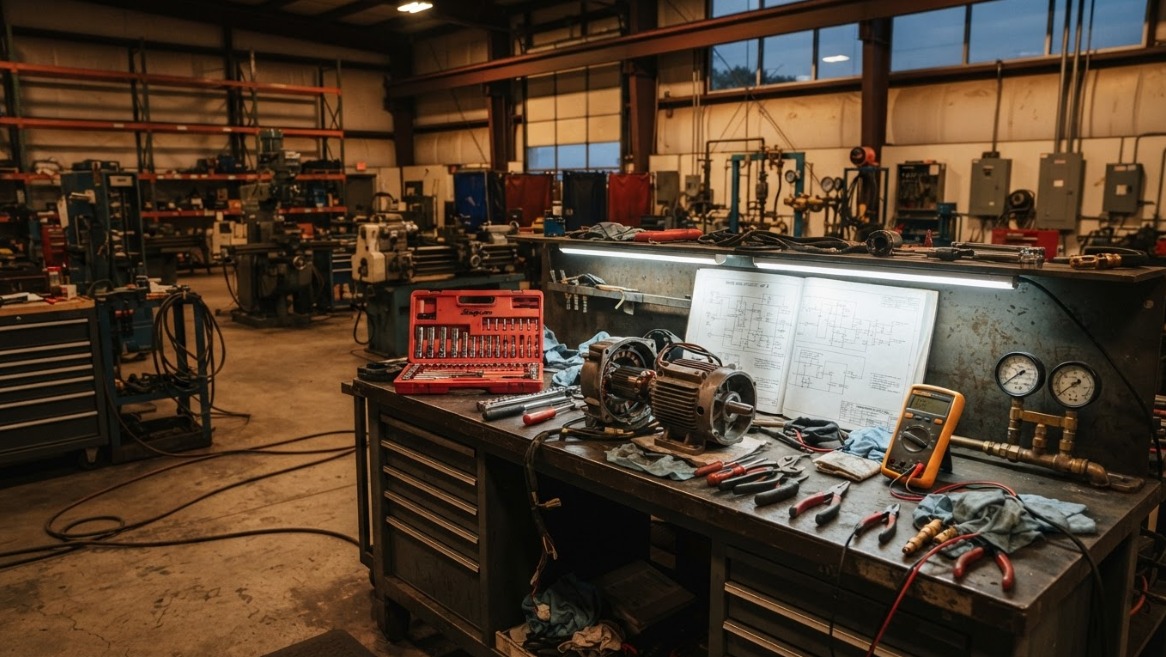
Before working on a machine, a technician shuts off its power and puts a personal padlock on the switch so nobody can turn it back on. OSHA estimates that this practice, called lockout/tagout, prevents about 120 deaths and 50,000 injuries every year.
The Numbers Behind the Career
About 51,900 openings for professionals in this field are expected over each year over the next decade.
About 547,300 people worked as industrial machinery mechanics, machinery maintenance workers, and millwrights, in the U.S. in 2025.
The median annual salary for professionals in this field was $64,100 in 2025.
Where This Career Is Headed
The most important trend is automation. The Bureau of Labor Statistics expects the continued adoption of automated manufacturing machinery to create jobs for these workers, because robots, automated conveyors, and computer-controlled equipment all need someone to keep them in good working order. The work itself is changing too. Predictive maintenance, which uses sensors and data to catch problems before failures happen, is shifting the job away from basic cleaning and lubrication and toward diagnostics and analysis. That shift explains why BLS projects strong growth for industrial machinery mechanics (18 percent) while projecting a small decline for machinery maintenance workers (minus 2 percent), whose simpler tasks are being absorbed by mechanics and by more efficient scheduling. Millwright employment is expected to stay roughly flat (1 percent), because some of the industries that employ them, such as paper mills, are growing slowly and new nonresidential buildings are less likely to require a millwright.

Automation and robotics maintenance. BLS points to automated conveyors as a likely area of high demand, since belts, motors, and rollers need regular care. Technicians who can service robots and computer-controlled machines will be most sought after.
Predictive maintenance specialties. Skills in vibration analysis, thermal imaging, and laser alignment let a technician move into higher-paid reliability roles. Credentials such as the SMRP Certified Maintenance and Reliability Technician (CMRT) recognize this expertise.
Employer-paid training. Large employers have built their own pipelines, including Toyota's FAME program, now run by The Manufacturing Institute, and Amazon's registered Mechatronics and Robotics Apprenticeship, both of which pay people while they train for maintenance roles.
Education & Certification
Industrial maintenance technicians typically need a high school diploma or equivalent, followed by a year or more of on-the-job training in which employers or equipment manufacturers teach shop math, blueprint reading, hand tool use, welding, electronics, and basic computer programming. Some technicians complete a two-year associate degree in industrial maintenance, with coursework in welding, mathematics, hydraulics, and pneumatics. Most millwrights learn through a three- or four-year apprenticeship that combines at least 144 hours of technical instruction each year with up to 2,000 hours of paid on-the-job training; apprentices must be at least 18 and have a high school diploma.
The National Institute for Metalworking Skills (NIMS) offers nine stackable Industrial Technology Maintenance credentials in areas such as maintenance operations, hydraulics, pneumatics, and electrical systems, and SMRP offers the Certified Maintenance and Reliability Technician (CMRT) exam.
To Prepare...
Take algebra, geometry, physics, and any shop, technology education, or robotics class your school offers. Reading measurements, understanding forces, and working safely with tools are the foundation of the trade.
Build hands-on experience at home: help with car or bike repairs, assemble furniture, or, with permission, take apart and rebuild a small appliance. Comfort with tools matters more than any single class.
Ask your counselor about career and technical education (CTE) pathways, dual-enrollment courses at a community college, and pre-apprenticeship programs. Some apprenticeships accept applicants at 18, so knowing the requirements early gives you a head start.
Spotlight: Explore the Life of a Industrial Maintenance Technician

Ricky Smith
Learn More
Society for Maintenance and Reliability Professionals (SMRP)
Learn More