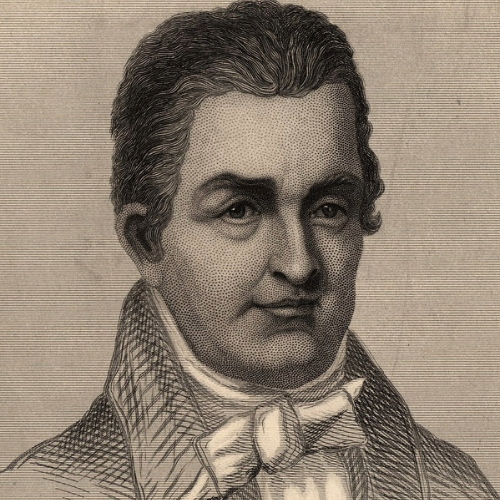
Photo: William G. Jackman, Public domain, via Wikimedia Commons
Oliver Evans
Who He Was
Oliver Evans (1755 to 1819) was born in Newport, Delaware, and started out as a wheelwright and wagon maker. In the early 1780s, he turned his attention to flour milling, an industry that needed many workers to produce a low-quality product. Around 1785, he built the first automated flour mill on Red Clay Creek, using bucket elevators, conveyors, and screw-driven devices so that grain moved through the entire process with almost no human labor. His design cut the crew needed to run a mill from four people to one. Evans received the third patent ever granted by the United States, signed by Thomas Jefferson, and George Washington had the gristmill at Mount Vernon converted to the Evans system. In 1795, Evans published The Young Mill-Wright and Miller's Guide, which went through fifteen editions and remained the standard textbook for the trade until after the Civil War.
Why He Matters
Evans's mill was the first fully automated industrial process in America, and every conveyor and bucket elevator in a modern factory descends from it. His book did something just as important for this career: it taught a generation of millwrights the principles of mechanical and hydraulic engineering, and those same millwrights went on to install and maintain the textile machinery of the early 1800s. The trade of keeping industrial machines running grew directly out of the knowledge Evans wrote down.