
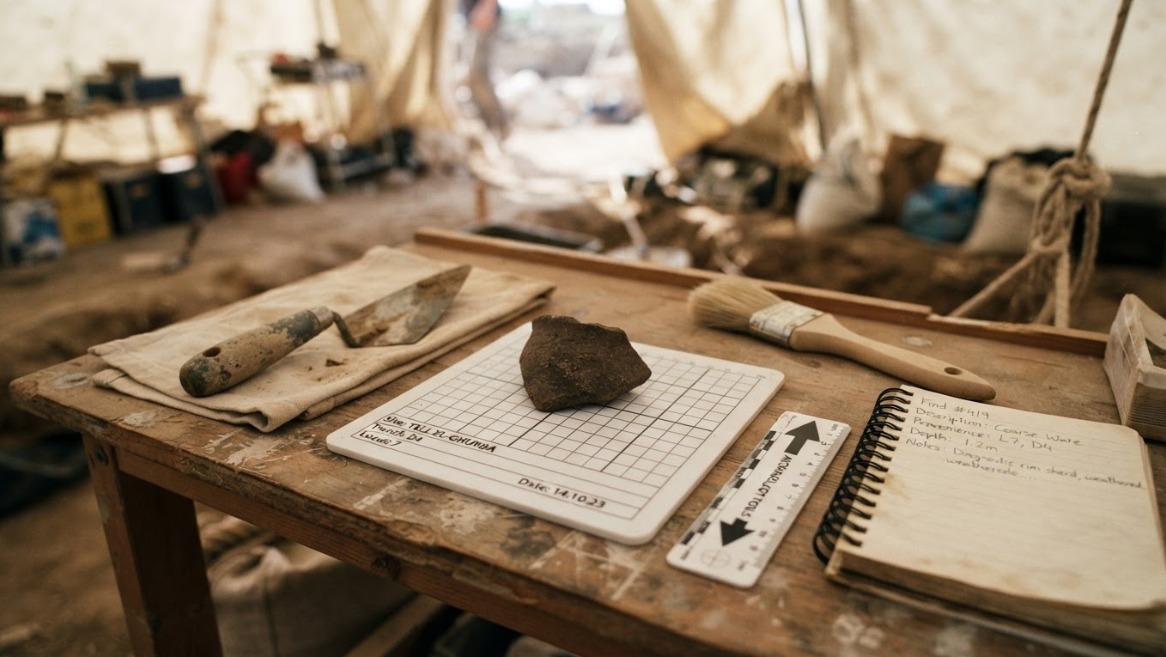
Did You Know?
A 5,300-year-old man found frozen in the Alps still had 61 tattoos, a copper axe, and an arrowhead lodged in his shoulder. Scientists even know what he ate for his last meal (ibex and red deer with einkorn wheat) and have traced the valley he climbed in the days before he died.
What Archaeologists Really Do
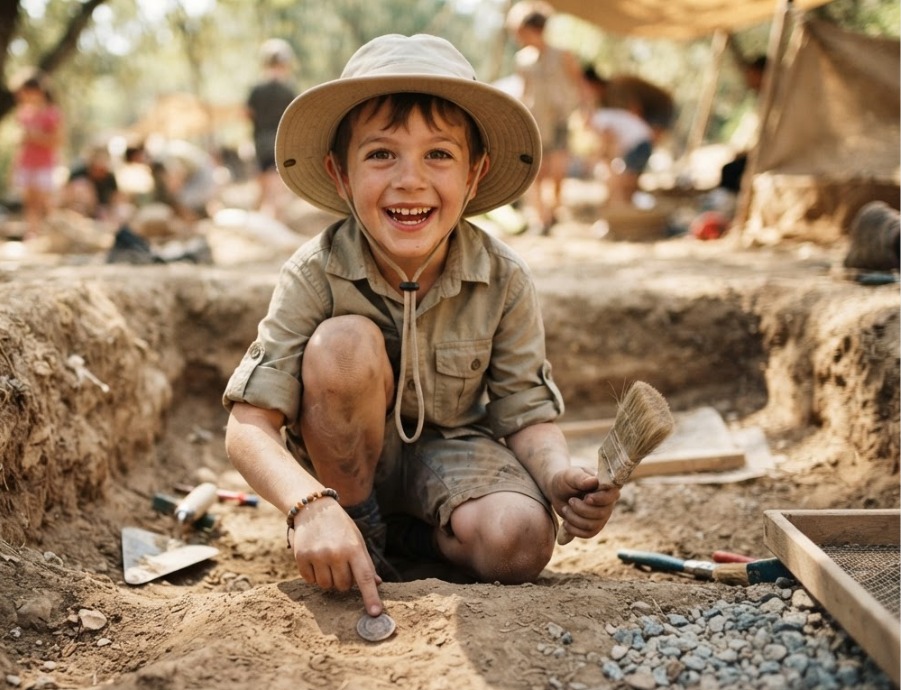
The sun is high, your knees are dusty, and the square of dirt in front of you is marked off with string like a tiny playing field. You sweep a soft brush back and forth, moving one thin layer of soil at a time into a dustpan, because rushing could break whatever is waiting underneath. The bristles catch on something hard and pale, and you slow down until just a curved edge shows, smooth and shaped by hands that are long gone. Before you lift it, out come the camera, the measuring tape, and the notebook, because exactly where an object sits in the ground is part of the story it tells. Even the dirt you brushed away goes into a bucket and through a screen, in case a bead or a bone or a tiny seed slipped past you.
This is the work of an archaeologist, a scientist who studies people who lived long ago by carefully uncovering the things they left behind. Bowls, tools, toys, jewelry, houses, and even seeds from old meals all count as evidence. People from the past did not leave instructions, so archaeologists build their stories out of clues, like a worn dip in a stone step that shows where thousands of feet once walked, or fish bones found far from any river that show food traveled a long way to get there. Some archaeologists work in deserts and jungles, some dig beneath city streets, and some search shipwrecks on the ocean floor. If you love mysteries, digging in the dirt, and asking "who was here before me?", you may already be thinking like an archaeologist.
You Might Love This If...
Skills That Follow You Everywhere
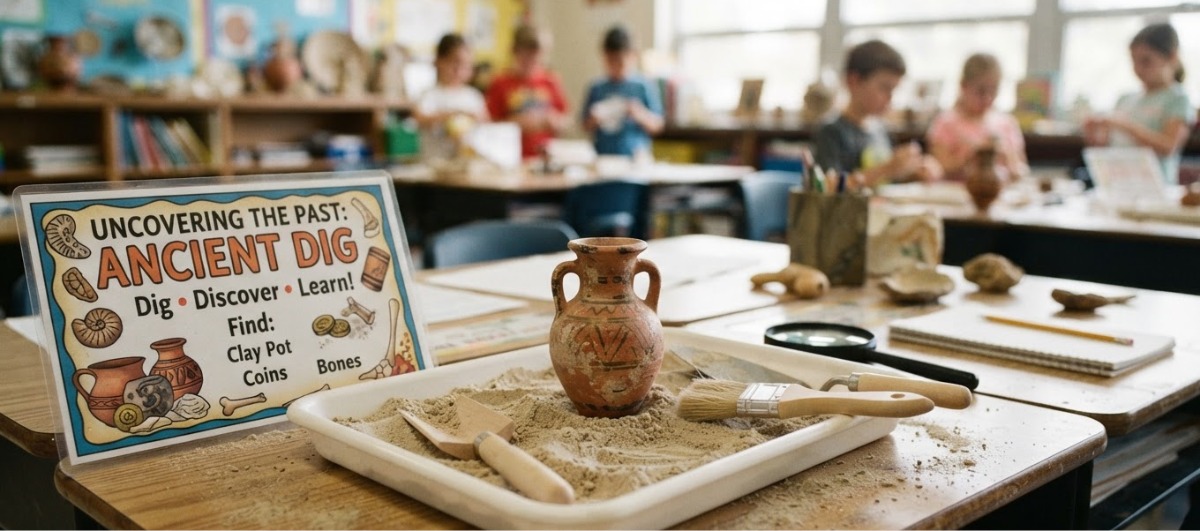
Archaeologists build habits of mind that reach well past the excavation unit. They learn to hold several possible explanations open at once without forcing a conclusion, to keep meticulous records under difficult conditions, and to work respectfully with people who have a personal stake in the history being uncovered. Those abilities matter in any field where evidence is incomplete, details carry weight, and the work affects people beyond the person doing it.
Critical Thinking
A broken pot found beside a hearth could mean a cooking accident, a ritual offering, or simply that someone swept their trash into a corner. Archaeologists have to weigh each possibility against the surrounding evidence and what similar sites have shown before committing to any one of them. The strongest archaeologists are the ones most willing to abandon a favorite theory when a new find contradicts it.
Empathy
Human remains, sacred objects, and ancestral homes are not just data to the communities descended from the people who left them. Archaeologists today consult with those communities about what to excavate, how to share findings, and what belongs in a museum versus what should be returned or reburied. Understanding why a discovery that thrills a researcher might feel like a violation to someone else is now considered a basic professional skill rather than an optional courtesy.
Organization
An artifact removed from the ground without a record of its exact depth, position, and surroundings loses most of what made it valuable, and no amount of later study can recover that information. Field notebooks, photographs, grid coordinates, sample bags, and catalog numbers must stay accurate across weeks of dusty, exhausting work. Sites are effectively taken apart in order to be studied, which means the records an archaeologist keeps become the only version of that place that survives.