
Did You Know?
A single second of animation in a traditional, hand-drawn film requires 24 individual drawings. That means a 90-minute animated movie could contain more than 129,000 separate images, each one drawn or painted by hand.
The Numbers Behind the Career
About 5,100 job openings for animators and special effects artists are projected annually over the next decade.
The 2023 median annual salary for special effects artists and animators was $106,900.
There were about 76,400 special effects artists and animators employed in the U.S. in 2023.
Where This Career Is Headed
Animation is expanding far beyond traditional film and television into areas that would have seemed like science fiction a generation ago. Real-time rendering engines, originally developed for video games, are now being used to produce feature films and interactive experiences that blur the line between watching and playing. Virtual and augmented reality are creating demand for animators who can build immersive three-dimensional environments that viewers can move through rather than just watch. The medical, scientific, and architectural fields are increasingly relying on animators to help visualize data and complex processes in ways that are accurate and engaging for broad audiences.
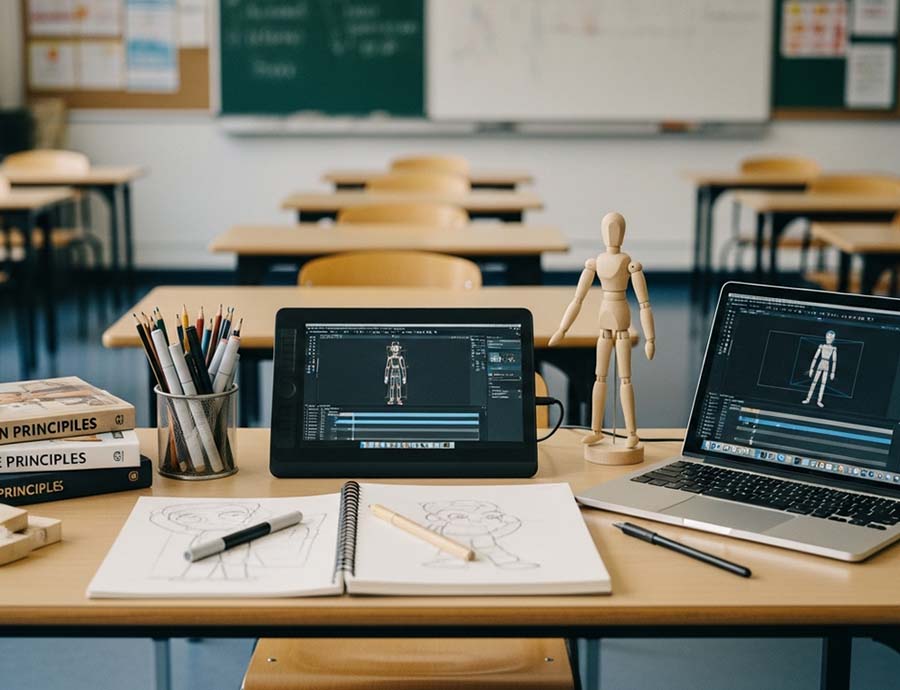
Real-time production pipelines, where animated content is rendered instantly rather than over long processing periods, will reshape how studios create films, series, and interactive experiences, opening new workflows and roles.
The growth of virtual and augmented reality will create demand for animators who can build spatial, interactive environments for immersive experiences rather than flat-screen interfaces.
Medical and scientific visualization will expand as hospitals, research institutions, and educators seek animators who can translate complex biological and physical processes into clear, accurate, and engaging visuals.
Education & Certification
Most professional animators hold a bachelor's degree in animation, fine arts, graphic design, or a related field, though strong portfolios can open doors regardless of educational background. University programs in animation typically cover drawing fundamentals, character design, digital production pipelines, storytelling, and software training in industry-standard tools like Autodesk Maya, Adobe Animate, and Toon Boom Harmony.
Community college programs and specialized art schools like CalArts, Ringling College, and SCAD offer focused animation training that connects students directly to industry networks. As animation intersects more with game development and interactive media, coursework in game engines like Unreal Engine and Unity is increasingly valuable.
To Prepare...
Take art, drawing, and theater classes at school. Art builds the observational and visual storytelling skills that every animator relies on, and theater develops an understanding of performance, timing, and emotion that directly shapes how animated characters move and behave.
Explore computer science and technology electives, which introduce the programming logic and digital tools that underpin modern animation software. Many schools also offer media production or digital arts courses where students can experiment with animation tools for the first time.
Take science and physics classes, which are the foundation for understanding how things actually move. Concepts like gravity, momentum, and force are the same principles animators apply when making a character jump, fall, or collide with something, and understanding them in the classroom makes them easier to apply creatively.
Spotlight: Explore the Life of a Animator


Explore more resources for a future Animator

The Art of My Neighbor Totoro: A Film by Hayao Miyazaki
Miyazaki, Hayao
Why We Picked It
Career Connection
Animators develop characters and worlds through thousands of sketches before a single frame is produced, and this book shows exactly how that process unfolds, from the first rough idea to the finished art filling the screen.

Animation Lab for Kids: Fun Projects for Visual Storytelling and Making Art Move - From cartooning and flip books to claymation and stop-motion movie making
Bellmont, Laura | Brink, Emily
Why We Picked It
Career Connection
Animators understand that motion is an illusion built frame by frame, and physically making zoetropes and flip books gives young creators a tactile feel for the fundamental principle behind everything from hand-drawn shorts to major studio features.

The Pixar Touch: The Making of a Company (Vintage)
Price, David A.
Why We Picked It
Career Connection
Animation is a collaborative art built on teams of artists, technologists, and storytellers solving hard problems together, and Pixar's origin story shows how that collaboration works at the highest creative level.