Photo: TVA Web Team, CC BY 2.0 <https://creativecommons.org/licenses/by/2.0>, via Wikimedia Commons
What It Is
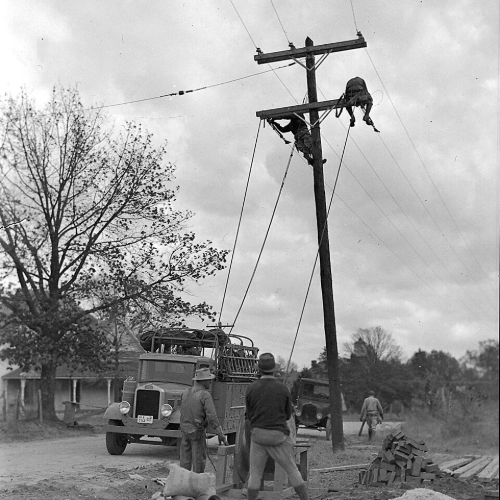
In the early 1930s, while cities across America hummed with electric light and modern appliances, roughly 90 percent of rural farms had no electricity at all. Private utility companies considered it too expensive to string power lines to scattered farms and small towns where the return on investment was uncertain. In 1935, President Franklin Roosevelt created the Rural Electrification Administration (REA) as part of the New Deal, providing federal loans to fund the construction of electrical distribution systems in underserved rural areas. When private utilities proved reluctant to participate, farming communities formed nonprofit electric cooperatives, pooled their resources, and hired linemen to build the lines themselves. Thousands of traveling linemen, known as "boomers," followed the work across the country, setting poles, stringing wire, and wiring farmhouses as they went.
Why It Matters
Rural electrification transformed American life on a scale that is difficult to overstate. Before electricity, farm families relied on kerosene lamps, wood stoves, hand pumps, and manual labor for tasks that electric power could accomplish in a fraction of the time. Electricity brought refrigeration, which meant food could be stored safely. It brought water pumps, which ended the daily chore of hauling water by hand. It brought radios, which connected isolated communities to the wider world. It brought electric milking machines, hay dryers, and grain elevators that made farming dramatically more productive. By 1950, close to 80 percent of American farms had electric service, up from about 11 percent in 1934. The linemen who built those lines did not just run wire from pole to pole. They closed the gap between rural and urban America, and they made modern agriculture possible. Many of the electric cooperatives they helped create still serve rural communities today.