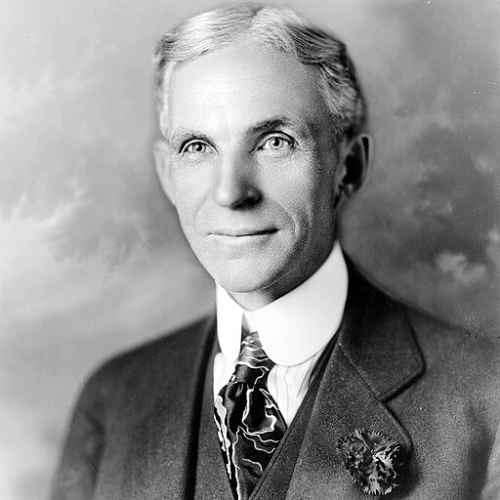
Photo: Fred Hartsook, Public domain, via Wikimedia Commons
Who He Is
Henry Ford was born on July 30, 1863, on a farm in Dearborn, Michigan, but from an early age, he was more interested in taking apart machines than in farming. By age 12, he had set up a small workshop, and at 15, he was dismantling and reassembling pocket watches so skillfully that neighbors brought him their broken ones to fix. At 16, he moved to Detroit to work as an apprentice machinist, eventually becoming the chief engineer at the Edison Illuminating Company. Working nights and weekends in a woodshed behind his home, he built his first automobile and test-drove his "Quadricycle" through the streets of Detroit in May 1896. After several failed business ventures, he founded the Ford Motor Company in 1903 with the goal of building "a motor car for the great multitude."
Why He Matters
Ford's manufacturing innovations had a bigger impact on the world than his cars. In 1913, his team of engineers at the Highland Park plant designed the moving assembly line for car production, breaking down the complex process of building a car into 84 separate tasks performed by different workers as the chassis moved on a powered conveyor. The production time for a single Model T dropped from over 12 hours to just 93 minutes, and the price fell from $850 in 1908 to $260 by 1924, making car ownership accessible to ordinary families for the first time. He also introduced the Five-Dollar Day in 1914, nearly doubling worker wages, and pioneered the eight-hour workday and five-day workweek. Ford did not invent the assembly line (earlier versions existed in meatpacking and other industries), but his team perfected a system that made mass production practical, affordable, and easy to replicate, and those methods were adopted by industries far beyond automobiles, transforming the production of everything from appliances to aircraft.