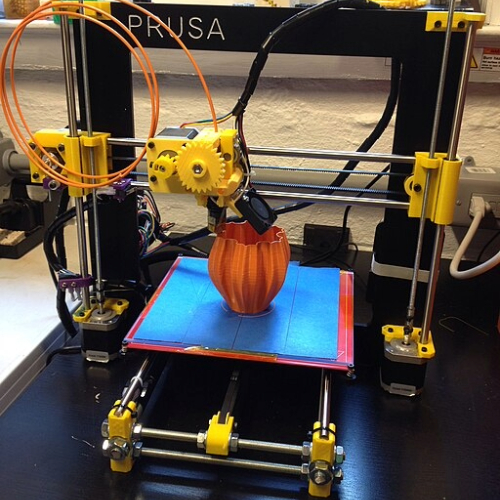
Photo: John Abella, CC BY 2.0 <https://creativecommons.org/licenses/by/2.0>, via Wikimedia Commons
3D Printing: The Invention That Builds Things Layer by Layer
What It Is
Throughout most of manufacturing history, creating a physical object involved starting with a block of raw material and removing material you didn't need through cutting, drilling, milling, and grinding until the desired shape appeared. In the early 1980s, a manufacturing engineer named Chuck Hull worked at a small California company that used ultraviolet light to harden protective coatings on tabletops. While experimenting with UV-curable resins, he realized that if he could control the light precisely enough, he could solidify thin layers of liquid resin one on top of another to build a three-dimensional object from the bottom up. On March 9, 1983, he produced the first-ever 3D-printed part. He filed a patent on August 8, 1984, coined the term "stereolithography," co-founded 3D Systems in 1986, and released the first commercial 3D printer, the SLA-1, in 1987.
Why It Matters
What started as a quick way to prototype has grown into a complete manufacturing technology. At first, 3D printing was only for quick prototypes, allowing engineers to print a physical test part overnight instead of waiting months for a machine shop. Today, additive manufacturing produces aerospace parts, custom medical implants, dental aligners, hearing aids, and prosthetic limbs. GE Aviation 3D-prints fuel nozzles for its LEAP jet engine, replacing what was once a set of 20 separate parts with a single printed piece that is 25% lighter and five times stronger. Consumer-grade 3D printers, affordable since around 2010, have brought the technology into homes, schools, and maker spaces worldwide. Hull, born in 1939 in Clifton, Colorado, received the National Medal of Technology and Innovation from President Biden in 2023, and was inducted into the National Inventors Hall of Fame in 2014 and the National Academy of Engineering in 2025. He once said he never imagined his invention would spread so far, initially thinking it was just a faster way to make prototypes.