Did You Know?
In 2005, a contagious virtual "plague" accidentally escaped its intended zone in the online game World of Warcraft and spread through the game's crowded cities. Epidemiology researchers later wrote about it in a medical journal, because players reacted a lot like real people do during an outbreak.
The Numbers Behind the Career
There are about 12,800 epidemiologist working in the United States, most often for state and local government health agencies.
About 800 openings for epidemiologist are projected each year over the next decade.
The median annual salary for epidemiologist in the U.S. was $87,220 in 2025.
Where This Career Is Headed
Over the next decade, epidemiology will be transformed by faster data and smarter tools. Artificial intelligence and machine learning are already helping researchers spot unusual patterns in enormous health data sets faster than any person could, sometimes flagging a possible outbreak days before official health alerts go out. Advances in genomic sequencing let scientists read a pathogen's genetic code, tracking exactly how a disease is spreading and changing in real time. At the same time, new challenges are emerging, including a changing climate that is shifting where mosquito-borne and other diseases can survive, along with the ongoing need to build public trust in the science that protects community health.
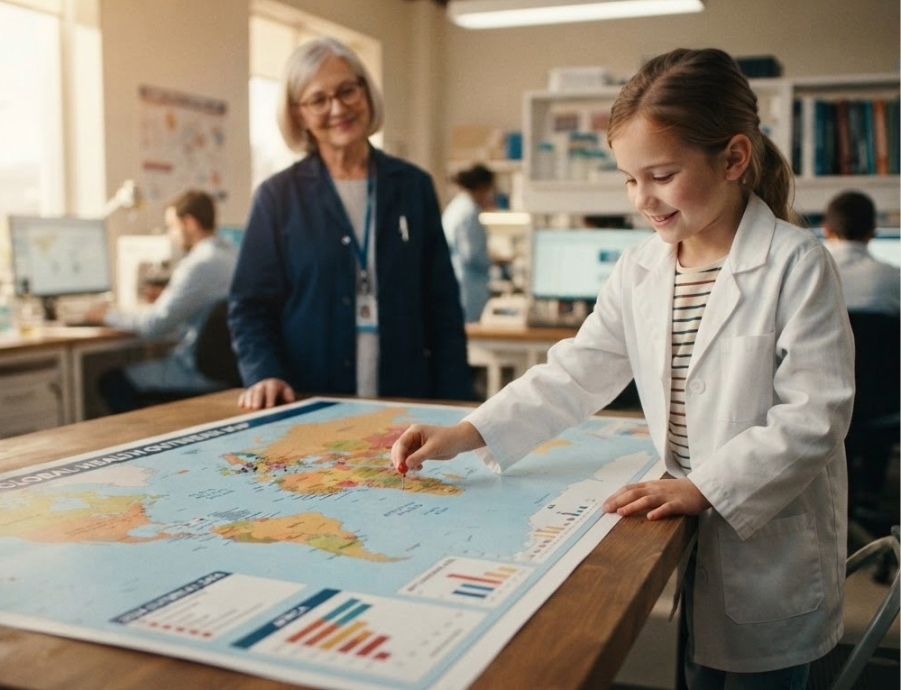
AI-powered disease surveillance systems will help epidemiologists detect outbreaks earlier by scanning huge amounts of health, travel, and environmental data for warning signs.
Advances in genomic sequencing will let epidemiologists track how a virus or bacterium evolves and spreads, making outbreak response faster and more precise.
Wastewater testing, which checks sewage for traces of germs, gives epidemiologists a new early-warning tool. In 2025, it detected measles in some communities days before doctors confirmed the first cases.
Education & Certification
Most epidemiologists start with a bachelor's degree in a field such as biology or a social science, then earn a master's degree, which is typically required to enter the field. The most common choice is a Master of Public Health (MPH) with a focus on epidemiology. Epidemiologists who direct research projects or teach at universities often also have a PhD or a medical degree. Professionals can pursue an optional credential, the Certified in Public Health (CPH) certification from the National Board of Public Health Examiners, to demonstrate their expertise. Coursework in biostatistics, epidemiological methods, and data analysis is a core part of most training paths into this career.
To Prepare...
Take as many math, biology, and statistics classes as you can, since epidemiology relies heavily on data and scientific reasoning.
Look for public health or science-related clubs, competitions, or summer programs, including the CDC Museum Disease Detective Camp for rising high school juniors and seniors.
Practice explaining scientific information in your own words, since communicating clearly is just as important as understanding the science itself.