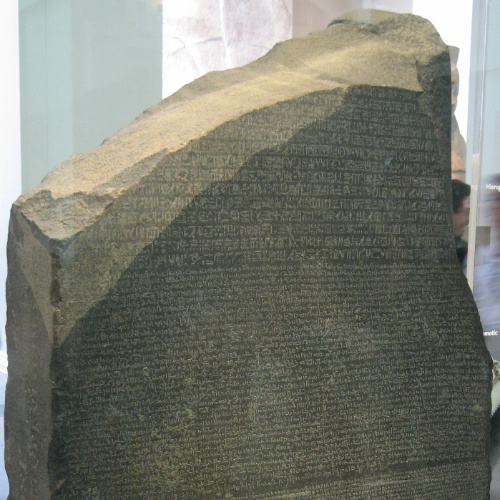
Photo: Olaf Herrmann, Copyrighted free use, via Wikimedia Commons
What It Is
In 1799, French soldiers rebuilding a fort near the Egyptian town of Rosetta uncovered a slab of dark gray stone carved with the same decree written three times, once in Egyptian hieroglyphs, once in Egyptian demotic script, and once in ancient Greek. Scholars could already read Greek, and because all three versions said the same thing, the stone became a key for translating a writing system nobody had been able to read for about 1,400 years. Cracking the code took more than twenty years. The English scholar Thomas Young made early progress by showing that some hieroglyphs spelled out the sounds of a royal name, and the French scholar Jean-François Champollion made the breakthrough in 1822 when he recognized that hieroglyphs were not purely symbolic pictures but a full writing system that recorded sounds as well as ideas. The Rosetta Stone has been displayed in the British Museum since 1802, and its removal from Egypt remains one of the most contested cases in the ongoing debate over who has the right to hold historical artifacts.
Why It Matters
Before the Rosetta Stone, thousands of years of Egyptian history, written in temples, tombs, and papyrus scrolls, sat unreadable, describing a civilization nobody could actually hear from in its own words. The stone did not just translate a language. It reopened a direct line to people who had been silent for well over a thousand years. Every hieroglyphic inscription decoded since, from tomb warnings to love poems to tax records, traces back to the method the stone made possible. It also set the template for how archaeologists think about lost languages more broadly, looking for that one bilingual bridge between what is known and what is not. It stands as a vivid example of how a single object, in the right hands, can unlock an entire lost world.