Photo: Forest Service Photography, Public domain, via Wikimedia Commons
What It Is
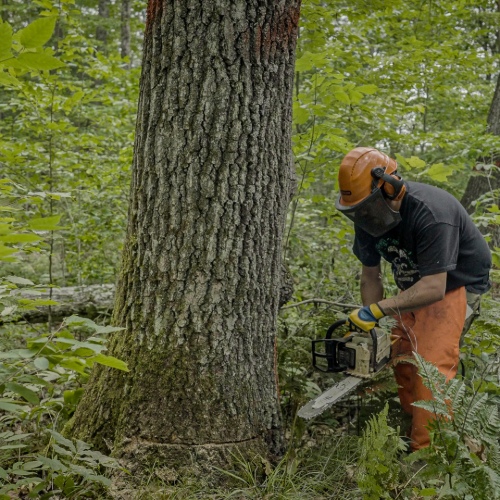
From space, the Menominee Forest in northeastern Wisconsin stands out as a dark green block against the cleared land around it. Since their reservation was created in 1854, the Menominee have cut trees there for lumber under a rule called sustained yield: harvest selectively and never take more than the forest grows back. Today, crews cut only about a third as much timber as the forest grows each year, and the tribe's own sawmill turns the wood into lumber and provides jobs for the community. The results are surprising: the forest held about 1.2 billion board feet of timber in 1854; since then, more than 2.25 billion board feet have been harvested, and about 1.7 billion board feet stand today, roughly 40 percent more than at the start. (A board foot is a piece of wood one foot long, one foot wide, and one inch thick.) Some of its white pines are more than 200 years old and over 150 feet tall.
Why It Matters
Every forester eventually faces the same tough question: how do you cut a forest for wood and still leave a forest? The Menominee have answered it with results anyone can measure by combining forestry science with Menominee values of caring for the forest for future generations. Their sustained-yield system was set up while loggers elsewhere in Wisconsin were cutting forests and moving on, and it is considered one of the first in the country. The tribally owned mill employs about 125 people, mostly tribal members, plus about 180 more who work in the woods. Foresters travel from around the world to walk the forest and see how it is managed.