Photo: Arne Hückelheim, CC BY 3.0 <https://creativecommons.org/licenses/by/3.0>, via Wikimedia Commons
What It Is
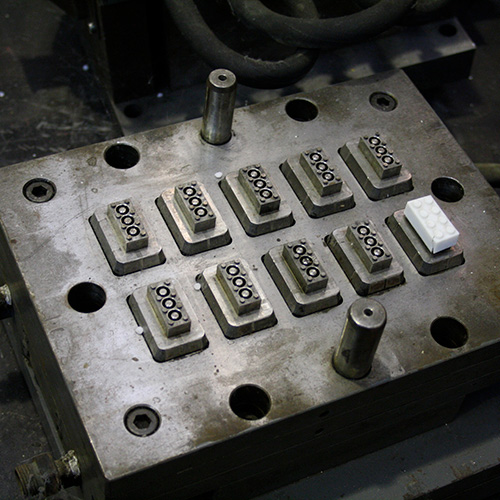
Every LEGO brick ever manufactured is shaped by a steel mold machined to a tolerance of 2 microns, roughly 50 times thinner than a human hair. Those molds are produced by teams of precision machinists at LEGO's manufacturing facilities in Denmark and Hungary, and they are so accurate that a brick produced today will connect seamlessly with one made in 1958. The molds themselves last for years, producing millions of identical bricks before they are retired, and every one of them starts as a solid block of hardened steel, which a CNC machinist programs to cut into shape. LEGO maintains one of the most rigorous quality control standards in consumer manufacturing, rejecting any brick that falls outside its dimensional specifications, which is why that satisfying click has not changed in almost seventy years.
Why It Matters
The LEGO mold is one of the most compelling arguments for why precision machining matters in everyday life. Most people never think about what it takes to make a toy that works perfectly every single time, across decades of production, in different factories, and in billions of individual pieces. The answer is machinists who hold tolerances that most people cannot even visualize. That satisfying snap reframes what CNC machining actually is: not an abstract industrial process, but the hidden craft behind the objects you grew up holding in your hands. The same precision that goes into a LEGO mold goes into the components of a jet engine, a surgical implant, and a space telescope, and it all starts with someone programming a machine to cut metal exactly right.