
Did You Know?
CNC machines never sleep. A single programmed machine can run unattended through the night, producing identical parts, which is why some manufacturing facilities operate what machinists call "lights-out" shifts, where the factory runs in complete darkness with no humans present.

What CNC Machinists Really Do
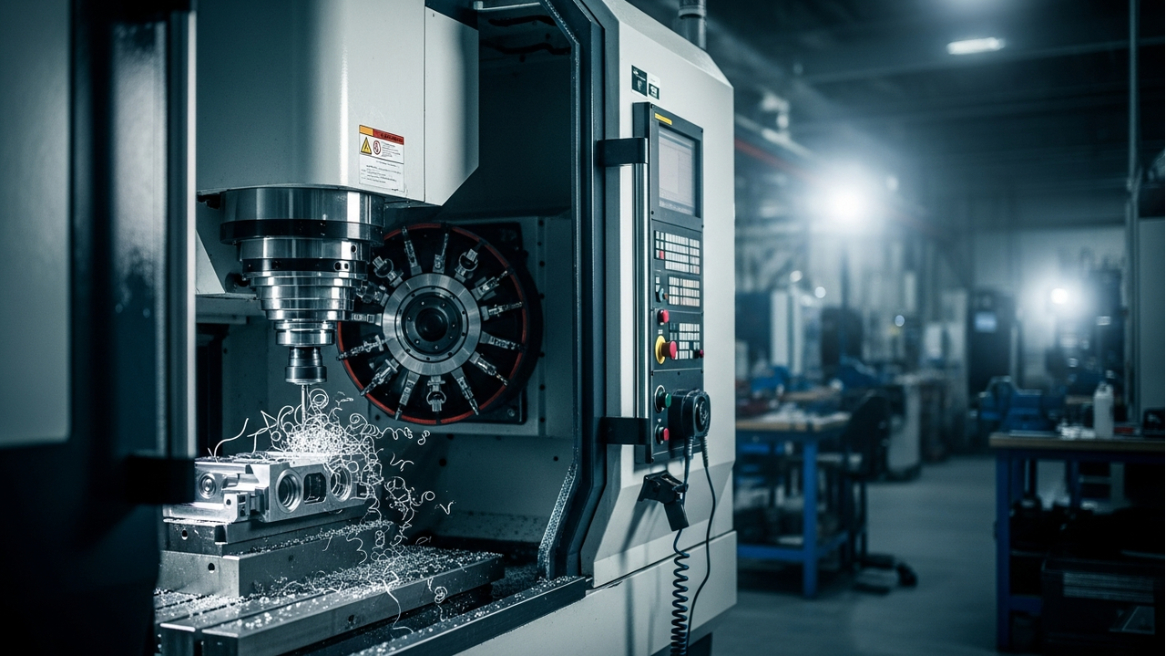
Next time you open a laptop, look at the smooth metal case and the tiny hinge that lets the screen fold back and forth thousands of times without breaking. Or think about the brakes on a bicycle, the gears inside a watch, or the small metal pieces inside a doctor's surgical tools. Parts like these have to be made so precisely that even being off by the width of a human hair could cause them to fail. A CNC machinist is the person who makes those parts. CNC stands for "computer numerical control," which means the machinist writes coded instructions that tell a powerful machine exactly where to cut, drill, and shape pieces of metal, plastic, or other materials into parts used in airplanes, robots, cars, medical devices, and even spacecraft.
Being a CNC machinist means you are part programmer and part builder. You write the instructions that tell the machine where to move and how deep to cut, set up the materials, choose the right tools, and make sure every single part comes out exactly right. It is a career that blends the satisfaction of creating something real with the challenge of programming and problem-solving. If you love figuring out how things are made and enjoy the idea of creating parts so precise they fit together perfectly every single time, you might already be thinking like a CNC machinist.
You Might Love This If...

Skills That Follow You Everywhere
Becoming a CNC machinist develops skills that extend far beyond programming machines and measuring parts. Machinists learn to push through costly mistakes and start over with the same focus they brought the first time, manage their work against tight production schedules where every minute of machine time has a dollar value, and find creative solutions to complex programming challenges that no manual can fully anticipate. These abilities are valuable in any career that demands precision, perseverance, and independent thinking under pressure.
Time Management
A CNC machine running a production job costs money every hour it is in operation, and a machinist who falls behind on setup, tooling, or programming creates a bottleneck that ripples across an entire production schedule. Machinists learn to plan their work carefully, anticipate how long each stage will take, and prioritize tasks so the machine is never waiting on them. That discipline around time, developed in an environment where delays are immediately visible and costly, builds habits that are valuable in any professional setting.
Resilience
When a machinist runs a flawed program on an expensive piece of raw material, the result is a scrapped part that cannot be undone, and the only path forward is to diagnose what went wrong, fix the code, and start again. That cycle of setback, analysis, and recommitment happens regularly in a machine shop, and the machinists who thrive are the ones who absorb those moments without losing confidence in their own judgment. Resilience in this career is not just about bouncing back from mistakes; it is about developing the kind of steady focus that prevents small errors from becoming expensive ones in the first place.
Creativity
Programming a CNC machine to produce a complex three-dimensional shape is not a mechanical process of following instructions. It requires the machinist to visualize how a cutting tool will move through material, invent efficient tool paths that minimize waste and machining time, and find solutions to geometric problems that often have no single right answer. The most skilled machinists approach their work the way a sculptor approaches raw stone, seeing the finished part inside the material before the first cut is made.
Explore more resources for a future CNC Machinist

The LEGO® Architect
Alphin, Tom
Why We Picked It
Career Connection
The dimensional consistency that makes architectural-scale LEGO building possible, every brick the same size every time, is the direct result of CNC-machined production molds, and building with those bricks gives kids an intuitive appreciation for what precision manufacturing enables.