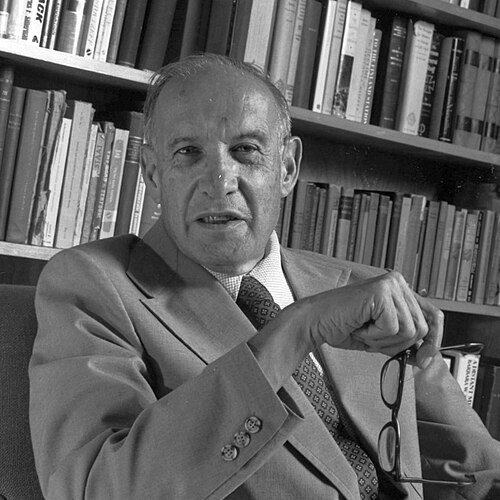
Photo: Jeff McNeill, CC BY-SA 2.0 <https://creativecommons.org/licenses/by-sa/2.0>, via Wikimedia Commons
Who He Was
Peter Drucker was an Austrian-born writer, professor, and management consultant who is widely regarded as the founder of modern management as a discipline. Born in Vienna in 1909 and educated across Europe before emigrating to the United States, Drucker spent decades studying how organizations actually function and translating those observations into frameworks that managers could put to work. He coined concepts that are now so embedded in professional life that most people do not know they came from a single person, including management by objectives, the knowledge worker, and the idea that the purpose of a business is to create a customer. He wrote more than 39 books over a career that spanned seven decades, and his clients included General Motors, IBM, and the American Red Cross.
Why He Matters
Drucker's lasting contribution was insisting that management is not an administrative function but a fundamentally human one, that the job of a manager is not to control people but to enable them to contribute their strengths toward a shared goal. That idea sounds obvious now because Drucker spent a lifetime making it obvious, writing and teaching with enough clarity and persistence that it eventually became the default assumption of professional management worldwide. His frameworks for thinking about organizational effectiveness, time management, decision-making, and institutional purpose are still taught in business schools and still applied in organizations across every sector. For students drawn to operations and management, Drucker is the person who defined what good management actually looks like and why it matters as much as any other professional discipline.