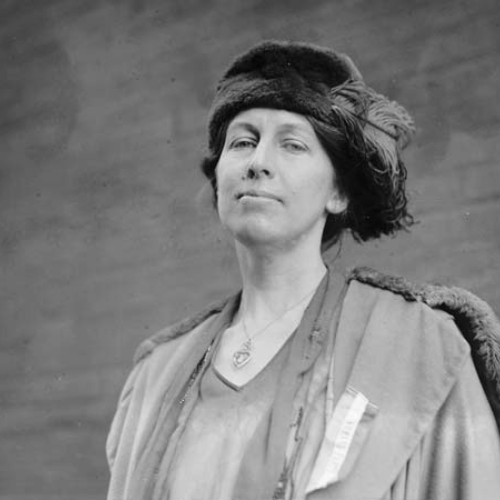
Photo: National Photo Company Collection/Library of Congress, Washington, D.C. (Digital File Number: LC-DIG-npcc-03521), Public domain, via Wikimedia Commons
Who She Was
Nora Stanton Blatch Barney was born in 1883 in Basingstoke, England. She came from a remarkable family of women who fought for equality. Her grandmother was Elizabeth Cady Stanton, one of the founders of the American women's suffrage movement, and her mother, Harriot Stanton Blatch, was also a prominent suffragist leader. After her family moved to the United States, Nora enrolled at Cornell University, where she studied civil engineering. In 1905, she became the first woman in the United States to earn a degree in civil engineering. That same year, she became the first woman admitted to the American Society of Civil Engineers (ASCE), though she was only allowed junior membership. She went on to work for the American Bridge Company, helping to construct bridges, and for the New York City Board of Water Supply, where she worked on the city's water infrastructure and conducted early research on how liquids and materials move through pipelines.
Why She Matters
Nora proved that women could excel in civil engineering at a time when almost no one believed they belonged in the profession. She worked as a chief draftsman at a steel construction company and as an assistant engineer for the New York Public Service Commission, gaining experience across bridge construction, steel design, and public infrastructure. When her first husband insisted she choose between being a wife and being an engineer, she chose engineering. In 1916, ASCE refused to promote her to full membership solely because she was a woman. She sued them in court, one of the first women to legally challenge gender discrimination in a professional engineering organization. She lost, but she never stopped working or advocating. Following the example of her grandmother and mother, she became president of the Women's Political Union and fought for women's right to vote. In 2015, nearly a century later, ASCE corrected its historic wrong by posthumously making Nora a Fellow of the Society. In 2017, New York City named a tunnel-boring machine after her in recognition of her contributions to the city's infrastructure and her role in opening the profession to women.