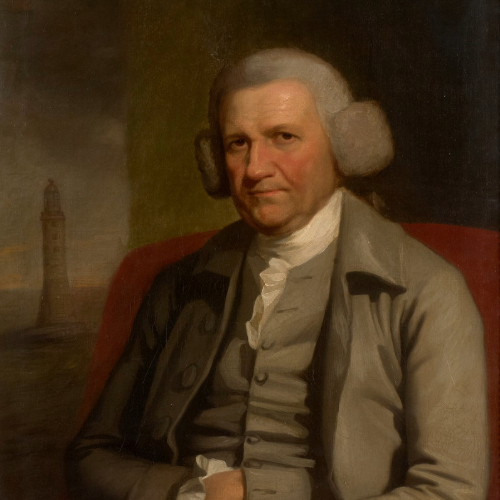
Photo: User Magnus Manske on en.wikipedia, Public domain, via Wikimedia Commons
Who He Is
John Smeaton was an eighteenth-century English engineer who is often called the father of civil engineering. Born in 1724 near Leeds, England, Smeaton trained as an instrument maker before turning his considerable talent toward practical engineering problems. His most celebrated achievement was the third Eddystone Lighthouse, completed in 1759, which stood on a wave-swept rock in the English Channel and was considered an almost impossible construction challenge. To build it, Smeaton invented a new type of hydraulic lime mortar that could set and harden underwater, a discovery that changed construction permanently and laid the groundwork for modern cement. He also improved the design of waterwheels and steam engines and worked on canals, harbors, and river navigation projects across England.
Why He Matters
John Smeaton matters because he turned engineering from a collection of practical craft traditions into a profession grounded in careful experimentation and scientific reasoning. His willingness to test materials, document results, and revise his approach based on evidence is exactly how civil engineers work today. The mortar he developed to build a lighthouse that could withstand the open ocean is a direct ancestor of the concrete that supports modern buildings, bridges, and dams. For young people, Smeaton's career is proof that asking the question "why does this material behave this way?" and being willing to experiment until you find the answer can produce discoveries that outlast any single building or project.