Photo: Smithsonian Institution from United States,Uploaded by Magnus Manske,Unidentified photographer, No restrictions, via Wikimedia Commons
Who She Was
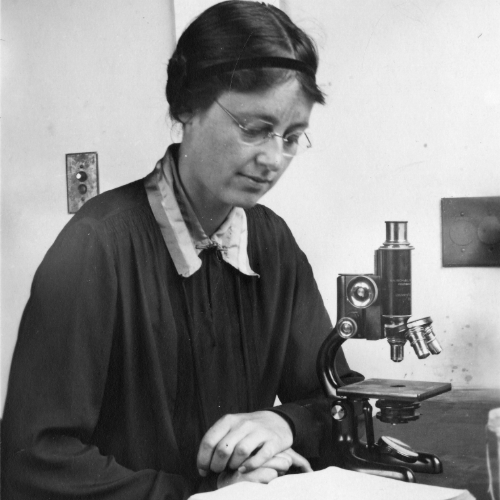
Kathleen Drew-Baker (1901–1957) was an English botanist at the University of Manchester who studied red seaweeds. When she married in 1928, the university dismissed her because it did not employ married women, so she carried on her research at the university as a research fellow rather than a lecturer. In 1949, she published a short paper that solved a mystery: a tiny, shell-boring organism scientists had thought was a separate species was actually a hidden stage in the life cycle of Porphyra, the seaweed used to make nori, the dark wrapper on sushi rolls. Porphyra spends part of its life as microscopic filaments living inside oyster and clam shells, which no one had realized. In Japan, where nori had been harvested since the 1600s, harvests were unpredictable and had collapsed after typhoons and coastal pollution; a scientist named Sokichi Segawa read her paper and applied it. Within about fifteen years, Japanese researchers had developed ways to seed nori nets on purpose, and the industry grew into the reliable business it is today.
Why She Matters
Drew-Baker never traveled to Japan or farmed a single sheet of nori, yet her discovery made nori farming possible, and she is honored there as the “Mother of the Sea.” A monument to her stands at a shrine in Uto, Kumamoto, where a festival in her name is held every April 14. Her story shows that aquaculture depends on understanding the full life cycle of whatever is being raised, which is exactly the knowledge hatchery and seaweed technicians use when they coax a species through the stages that happen out of sight. It also shows how a discovery in one country’s laboratory can reshape an industry on the other side of the world. She represents the science behind the career, and the persistence of a researcher who kept working after her university dismissed her.