Photo: Columbia GSAPP, CC BY-SA 2.0 <https://creativecommons.org/licenses/by-sa/2.0>, via Wikimedia Commons
Who She Was
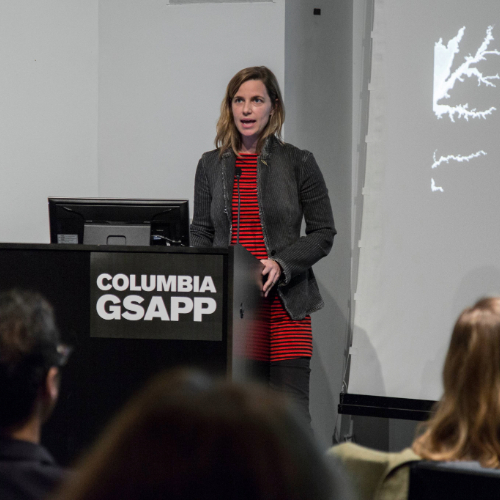
Kate Orff founded her landscape architecture firm, SCAPE, in New York City in 2007 around a simple but unusual idea: that a coastline can be protected by something alive rather than something poured out of concrete. Her early project Oyster-tecture, created in 2010 for a Museum of Modern Art exhibition about New York’s waterfront, proposed growing reefs of oysters in the harbor, using the natural filtering power of the shellfish to clean the water while their reef structures absorb wave energy during storms. That idea became real as Living Breakwaters, a chain of eight rock breakwaters, each about 400 feet long, built off the south shore of Staten Island and finished in 2024. The structures are designed to blunt storm waves and slow erosion while giving oysters and other marine life a place to grow, and tens of millions of oyster larvae have already been seeded onto them. In 2017, she became the first landscape architect ever awarded a MacArthur Fellowship. She also directs the urban design program at Columbia University and co-directs its Center for Resilient Cities and Landscapes.
Why She Matters
Orff’s work argues that the strongest coastal defenses might not be walls at all, but living systems that grow stronger and more effective over time. An oyster reef does not just sit there the way a seawall does. It filters water, builds habitat, and can regenerate after damage. Her approach pushed engineers and city planners to take a landscape architect’s ideas seriously as flood protection, not just decoration layered on top of “real” infrastructure, and Living Breakwaters was funded as part of the federal recovery effort after Hurricane Sandy. It also reframed coastal cities as places that could work with the water they border, rather than only building higher walls against it. Her career shows that some of the best solutions to a hard problem come from looking at how nature already solves it.