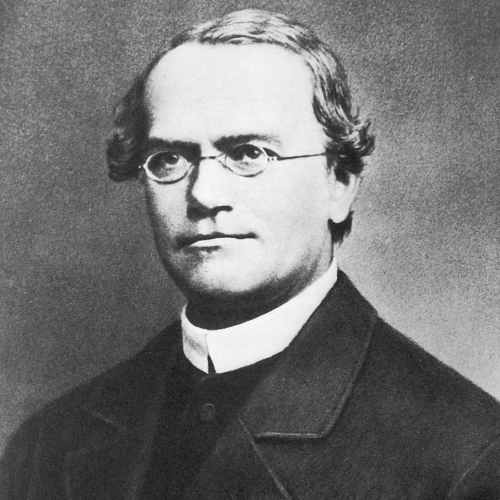
Photo: http://0.tqn.com/d/biology/1/0/l/e/3244238.jpg, Public domain, via Wikimedia Commons
Who He Was
Gregor Mendel was a monk and scientist born in 1822 in what is now the Czech Republic. Growing up on a small farm, he learned to care for plants, and later joined a monastery where he could study and teach science. Between 1856 and 1863, he carefully grew and cross-bred nearly 30,000 pea plants in the monastery garden, tracking traits like flower color, seed shape, and plant height across generations. He discovered that traits are passed down in predictable patterns through tiny "factors" from each parent, which we now call genes. Mendel published his findings in 1866, but almost no one paid attention during his lifetime.
Why He Matters
Mendel's pea experiments laid the foundation for the entire science of genetics. About 16 years after his death, scientists rediscovered his work and realized he had explained the basic rules of inheritance decades before anyone else. His story shows the power of patience, careful observation, and keeping good records, even when no one is cheering you on. For young people, Mendel is proof that big discoveries can start with something as simple as a garden and a question.