Photo: Smithsonian Institution/Science Service; Restored by Adam Cuerden, Public domain, via Wikimedia Commons
Overview
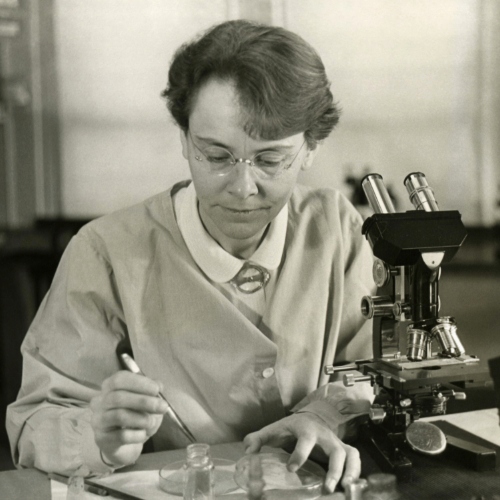
Barbara McClintock was an American geneticist born in 1902 in Hartford, Connecticut, who spent her career studying the genes of corn. As a student at Cornell University, she fell in love with genetics at a time when few women were welcome in science. Working in her cornfield and lab at Cold Spring Harbor Laboratory in New York, she noticed that the colorful speckles on corn kernels changed in surprising ways from one generation to the next. In the 1940s, she discovered that some genes can actually move from one spot on a chromosome to another, switching other genes on and off. These "jumping genes" were so unexpected that many scientists doubted her for decades.
Why She Matters
McClintock's discovery changed how scientists understand DNA, showing that the genetic code is not fixed in place but can shift and rearrange. Other researchers eventually found jumping genes in bacteria, animals, and people, and today they help scientists study everything from antibiotic resistance to cancer. In 1983, at age 81, she won the Nobel Prize in Physiology or Medicine, becoming the first woman to win that prize on her own. Her story shows young people the value of careful observation, trusting the evidence, and staying curious even when others do not believe you yet.