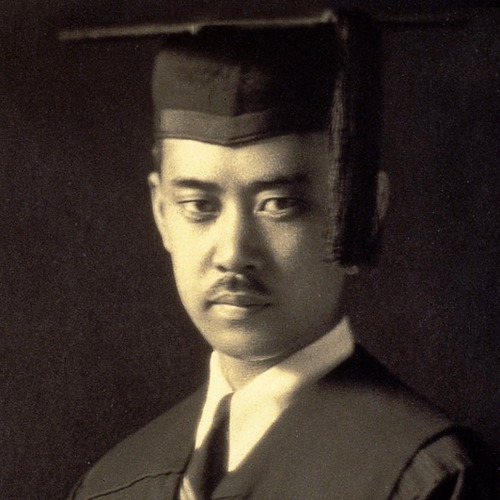
Photo: See page for author, Public domain, via Wikimedia Commons
Who He Is
George Nakashima was born in 1905 in Spokane, Washington, the son of Japanese immigrants. As a boy, he developed a deep love of nature while exploring the mountains of the Pacific Northwest with the Boy Scouts. He studied architecture at the University of Washington and earned a master's degree from MIT in 1931. After graduating, he traveled the world, working in France, Japan, and India, where he studied traditional building methods and discovered that his true calling was working with wood rather than designing buildings. When he returned to the United States, he began making furniture and teaching woodworking in Seattle. After the attack on Pearl Harbor, Nakashima, his wife Marion, and their newborn daughter Mira were forcibly sent to the Minidoka internment camp in Idaho alongside 120,000 other Japanese Americans.
Why He Matters
While imprisoned at Minidoka, Nakashima met Gentaro Hikogawa, an experienced carpenter trained in traditional Japanese woodworking. Under Hikogawa's guidance, Nakashima learned to master Japanese hand tools and joinery techniques, and he developed the patience and discipline that would define his life's work. After his release in 1943, he settled in New Hope, Pennsylvania, where he built his own workshop and began crafting furniture by hand. Nakashima believed that wood was not just a material but something alive, and that a woodworker's job was to give a tree a "second life" by revealing the natural beauty hidden in each piece. His signature style used large wood slabs with natural, unfinished edges joined by butterfly joints, the same technique he learned in the internment camp. He received the Order of the Sacred Treasure from the Emperor of Japan in 1983, and his furniture is displayed in museums around the world. His studio is still active today, led by his daughter Mira, who trained at Harvard and worked alongside her father for decades. Nakashima's story shows how a carpenter's craft can transcend hardship and become a lifelong pursuit of beauty and peace.