

Did You Know?
Adrian Hill, the British artist credited with coining the term “art therapy” in 1942, later hosted Sketch Club, a children’s TV show on the BBC.
What Art Therapists Really Do
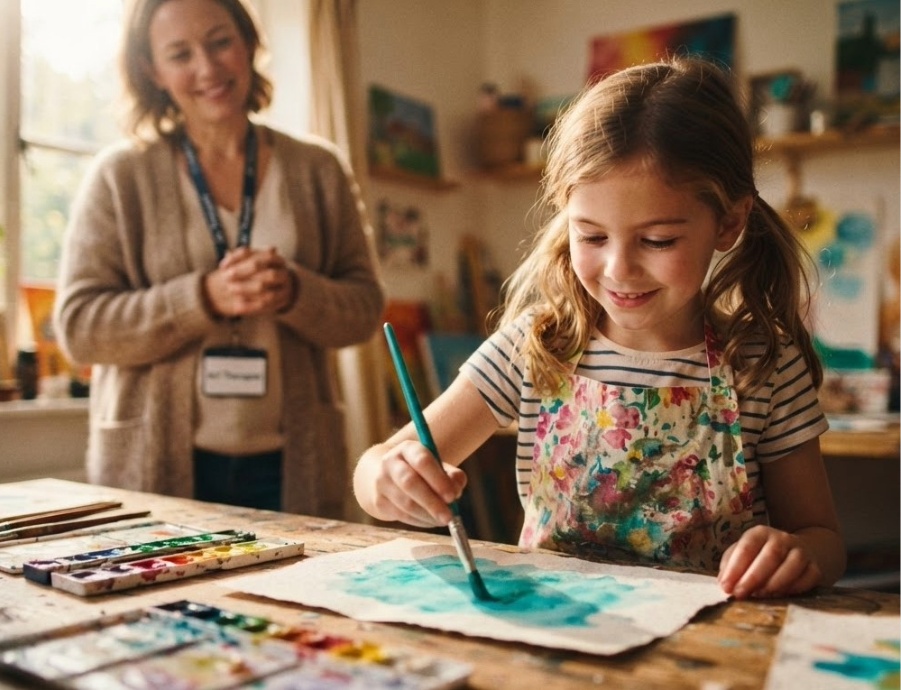
A kid sits at a small table in a quiet room, a blank sheet of paper in front of them and a box of markers nearby. They haven’t said much all morning, but you slide the paper closer and invite them to draw how today feels, with no rules about what it has to look like. Slowly, jagged red lines fill the page, not like a picture, more like a feeling let loose on paper. You watch how they work, like how hard they press and which colors they keep reaching for, and you wait instead of guessing what it means. This is how an art therapist helps someone share a feeling they might not have words for yet.
Art therapists are people who help others feel better by using drawing, painting, and other kinds of art, not just by talking. Sometimes a feeling is too big, too scary, or too confusing to explain out loud, and making something with your hands can let it out a different way. Art therapists work with kids and adults dealing with hard things, like illness, fear, or difficult situations at home. They pay close attention to how a person makes art and what they choose to make, and they ask gentle questions instead of guessing what a picture means. If you love art, care about helping people feel better, and think a drawing can sometimes say more than words, you might already be thinking like an art therapist.
You Might Love This If...
Skills That Follow You Everywhere
Art therapists develop skills that extend well beyond art-making itself. They learn to sense what someone is feeling before it is said out loud, to adapt their approach creatively for whoever is in front of them, and to weigh what they notice carefully before deciding what it means. Those abilities carry over into any career that depends on understanding people deeply, thinking carefully about what you observe, and meeting someone exactly where they are.
Critical Thinking
A single detail in a drawing, like a small figure placed alone in a corner, could mean something important or nothing at all. Art therapists have to weigh what they see against what they know about the person, the session, and the setting before drawing any conclusion. Resisting the urge to decide what a picture means, and asking careful questions instead, is what keeps an interpretation accurate.
Creativity
No two clients respond to the same technique the same way, so an approach that helps one person open up might completely shut another one down. Art therapists constantly adapt, inventing new exercises, materials, or prompts on the spot to fit whoever is in front of them, whether that’s a scared child, a veteran, or a teenager going through a hard change. The best art therapists treat each session like a new creative problem to solve, not a script to follow.
Empathy
A child drawing a scribble of jagged red lines may be showing a feeling they don’t have words for yet. Art therapists have to sense what’s underneath someone’s art without rushing them to explain it, staying patient even when a breakthrough takes weeks to arrive. Understanding someone else’s pain closely enough to guide them through it, without taking on that pain as your own, is a skill this work demands every single day.