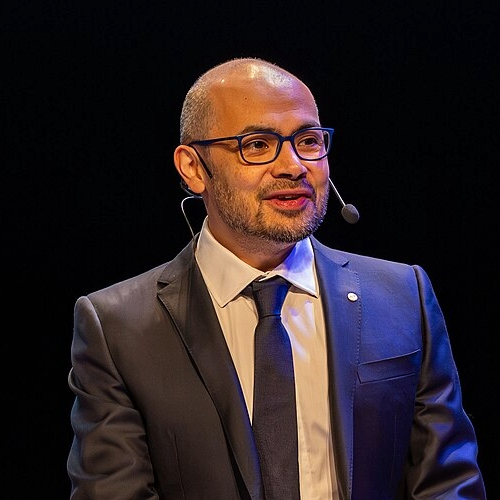
Photo: G.emmerich, CC BY-SA 3.0 <https://creativecommons.org/licenses/by-sa/3.0>, via Wikimedia Commons
What It Is
One of the most remarkable things about AI research is its culture of sharing. Unlike many industries where companies guard their secrets, AI researchers have built a tradition of publishing their discoveries freely so that anyone in the world can read, learn from, and build upon them. At the center of this culture is ArXiv (pronounced "archive"), a free online library where scientists upload their research papers before they are even reviewed by a journal. Founded in 1991 by physicist Paul Ginsparg from a server stored beneath his desk at Los Alamos National Laboratory, ArXiv was originally created for physics papers. It has since grown to host nearly 2.4 million articles across computer science, mathematics, biology, and more. When a team of AI researchers makes a breakthrough, their paper often appears on ArXiv within days — meaning a student in Tokyo, a professor in Nairobi, or a curious teenager anywhere with internet access can read the same cutting-edge research at the same time.
Why It Matters
This openness is not limited to papers. AI researchers routinely share the actual computer code behind their discoveries on platforms like GitHub, and they publish their trained models on sites like Hugging Face so that others can test and improve them. Open datasets, such as the famous ImageNet collection of millions of labeled photographs, have been made available for free and have powered some of the field's biggest breakthroughs. This sharing culture exists because researchers recognized early on that science moves faster when people build on each other's work rather than starting from scratch. It also means the field is remarkably accessible — many of the world's leading AI researchers did not start at elite institutions but taught themselves by reading freely available papers, downloading open-source code, and experimenting on their own. For aspiring AI researchers, this is exciting news: the same knowledge that top scientists use is available to anyone willing to learn.