Photo: Arthur Petron, CC BY-SA 4.0 <https://creativecommons.org/licenses/by-sa/4.0>, via Wikimedia Commons
Who He Is
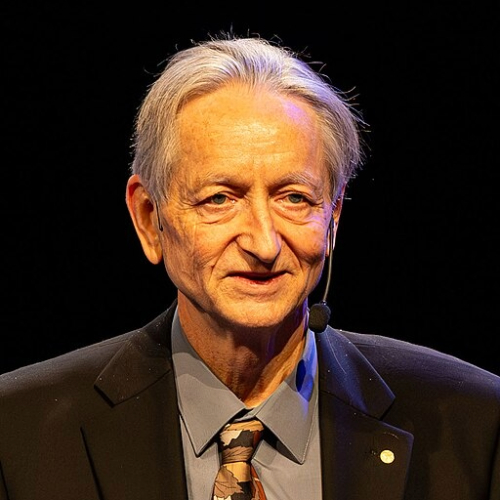
Geoffrey Hinton is a British-Canadian computer scientist widely known as the "Godfather of Deep Learning." Born in London, England, in 1947, Hinton became fascinated with how the human brain works and spent decades researching artificial neural networks, a type of AI inspired by the brain's structure. For many years, most of the scientific community considered his ideas impractical, but Hinton persisted. He earned his Ph.D. from the University of Edinburgh and held positions at Carnegie Mellon University and the University of Toronto, where he spent most of his career. His research on backpropagation and deep neural networks became the foundation of modern AI. He shared the 2018 Turing Award, often called the "Nobel Prize of Computing," with Yoshua Bengio and Yann LeCun, and in 2024, he was awarded the Nobel Prize in Physics for his work on artificial neural networks.
Why He Matters
Hinton's importance to AI cannot be overstated. The techniques he developed and championed, particularly deep learning and backpropagation, are now used in virtually every AI application, from voice assistants and language translation to medical diagnosis and autonomous vehicles. What makes his story particularly compelling is that he spent decades working on ideas that most researchers dismissed. His persistence through what are called "AI winters," periods when funding and interest in neural networks dried up, demonstrates the importance of believing in your research even when the results are not immediate. In recent years, Hinton has also become one of the most prominent voices warning about the potential risks of advanced AI, leaving his position at Google in 2023 to speak freely about the importance of AI safety. His career shows that great scientists not only push boundaries but also take responsibility for the impact of their work.