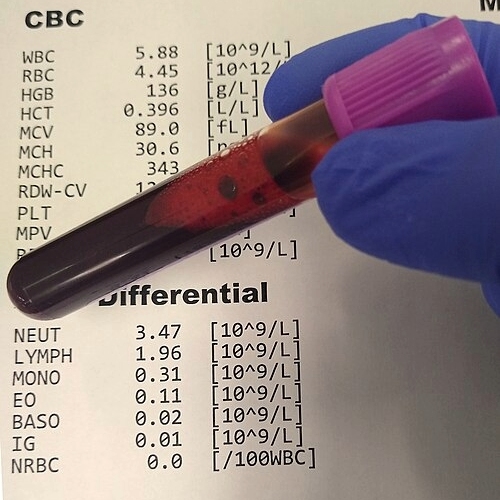
Photo: SpicyMilkBoy, CC BY-SA 4.0 <https://creativecommons.org/licenses/by-sa/4.0>, via Wikimedia Commons
What It Is
The complete blood count, universally known as the CBC, is the most commonly ordered laboratory test in medicine and one of the most informative single tests available to a clinician. It measures the number and characteristics of red blood cells, white blood cells, and platelets in a sample of blood, generating a panel of values that can reveal anemia, infection, clotting disorders, leukemia, and dozens of other conditions, depending on which numbers fall outside their normal ranges and in what combination. A modern automated hematology analyzer can process a CBC in under two minutes, but the interpretation of the results, recognizing which abnormalities are clinically significant, which might be artifacts of sample handling, and which warrant immediate physician notification, requires the trained judgment of a medical laboratory professional. The CBC was first developed in its modern form in the mid-20th century, as automated cell-counting equipment made it possible to measure blood cell populations with precision and speed that manual microscopy could not match. Today, it is ordered as part of routine wellness exams, pre-surgical screenings, and emergency evaluations, making it one of the most widely performed laboratory tests across the healthcare system.
Why It Matters
The CBC matters because it demonstrates, in a single test, what medical laboratory science is actually for. It takes something invisible to the naked eye, the microscopic composition of a patient's blood, and translates it into precise, actionable information that a physician can use to make decisions that directly affect a patient's health. A CBC that shows a dramatically elevated white blood cell count might be the first sign of leukemia. One that shows critically low platelets might explain why a patient is bleeding unexpectedly. One that shows abnormal red blood cell morphology might reveal a hereditary condition that the patient did not know they had. Every one of these findings starts with a laboratory technician running a test, evaluating the result, and deciding what happens next, which is as good a description of the profession as any.