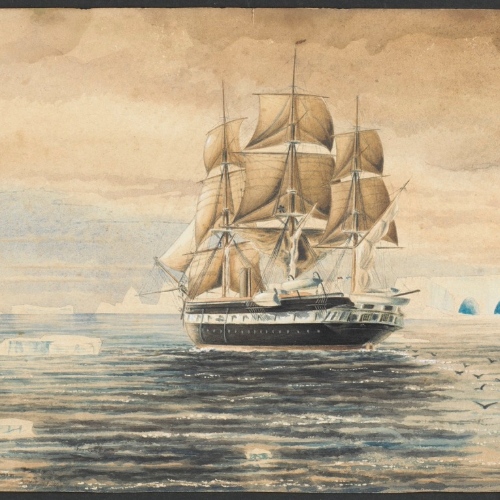
Photo: Herbert Swire, Public domain, via Wikimedia Commons
What It Is
Between 1872 and 1876, a converted British warship called HMS Challenger sailed nearly 69,000 nautical miles (about 79,000 miles) across the world’s oceans on a mission unlike anything attempted before: to systematically study the ocean itself, rather than simply sail across it to get somewhere. Fifteen of the ship’s seventeen guns were removed to make room for laboratories, and a team of six scientists took depth measurements, water samples, and temperature readings at hundreds of stations while dredging up thousands of specimens from the deep seafloor. About 4,700 of those specimens turned out to be species no one had ever seen or classified before. In 1875, the crew recorded the deepest sounding ever measured at the time, in a trench between Guam and Palau that was later named the Challenger Deep in the ship’s honor. It remains the deepest known point in the ocean today. The report that resulted from the voyage took nineteen years to fully publish and ran to fifty volumes, becoming the foundational reference for an entirely new scientific field.
Why It Matters
The Challenger Expedition marked the moment ocean study became an organized science with its own methods, rather than a side effect of exploration or trade voyages. Before it, ideas about the deep sea were mostly speculation. It proved that systematically measuring and sampling the ocean, rather than only observing it from the surface, could reveal an entire hidden world of life and physical processes. The sheer scale of the data collected, covering depth, temperature, chemistry, and biology across every major ocean, set a model for large, coordinated scientific expeditions that researchers still follow today. The Challenger Deep, first measured by the expedition more than 150 years ago, remains a place scientists continue to study and explore. The expedition stands as proof that a single well-designed voyage can lay the groundwork for an entire scientific discipline.