Photo: Vicky Cullen, Public domain, via Wikimedia Commons
Who He Was
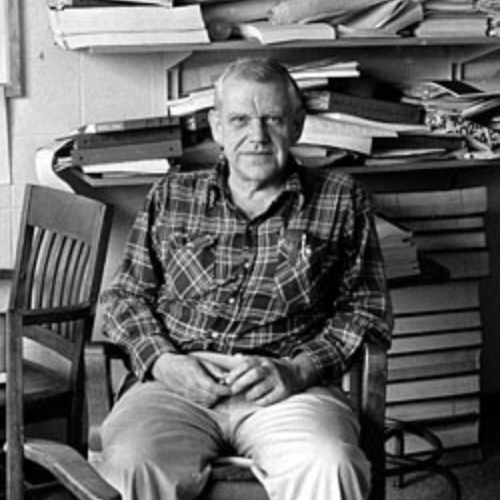
Henry Stommel (1920–1992) was an American oceanographer who became fascinated with a simple question that nobody could fully explain: why do powerful ocean currents like the Gulf Stream hug the western side of the ocean instead of running down the middle? In 1948, he worked out the mathematics explaining why strong currents form along the western edges of ocean basins rather than spreading evenly, a theory that became foundational to the entire field of physical oceanography. He went on to study how temperature and saltiness drive deep ocean currents, laying groundwork for understanding the massive global circulation system that moves water around the planet over the course of centuries. Stommel was unusual in being both a groundbreaking theorist and a skilled seagoing observer, often working out how the ocean should behave on paper and then heading to sea to check. He spent his career at Woods Hole Oceanographic Institution, Harvard, and MIT, became a full professor without ever earning a doctorate, and received the National Medal of Science in 1989.
Why He Matters
Stommel helped turn oceanography from a field based mostly on description and observation into one grounded in rigorous physics and mathematics. His explanation for why currents like the Gulf Stream behave the way they do is still taught to every student of physical oceanography today. By showing that complex ocean behavior could be predicted and explained mathematically before it was fully observed, he helped establish theory as a powerful tool for understanding the ocean, not just a supplement to fieldwork. His early models of deep ocean circulation also suggested that the system might have more than one stable state, an idea that remains central to how scientists think about the ocean’s role in climate. He represents the side of oceanography built on solving the ocean like a puzzle of physics and math, long before supercomputers could run the models for you.