Photo: Created with Google Gemini
NASA's in-Space Manufacturing Program
What It Is
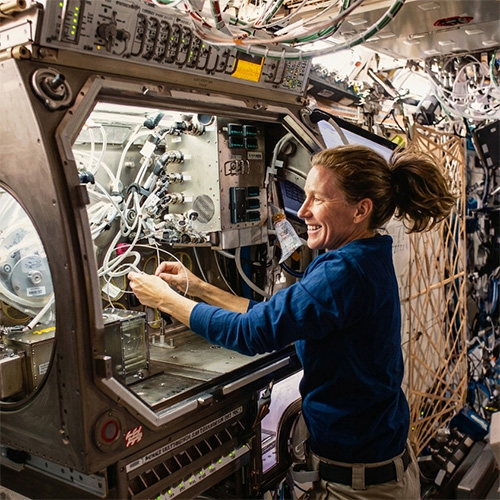
In 2014, NASA sent the first 3D printer to the International Space Station, and astronauts used it to print a ratchet wrench from a design file emailed from Earth, the first time a tool had ever been manufactured in space on demand. The experiment was the beginning of what NASA now calls its in-space manufacturing program, an effort to develop the capability to produce tools, replacement parts, and eventually structural components during long-duration missions rather than carrying every possible spare part from Earth or waiting months for resupply. The program has since expanded to include research into printing with materials found on the Moon and Mars, including lunar regolith, the powdery surface material of the Moon, which could theoretically be used to print habitats and infrastructure for future human settlements without shipping building materials from Earth. NASA has also explored printing food, electronics, and medical devices in microgravity, each presenting unique technical challenges that have pushed the boundaries of what additive manufacturing can do.
Why It Matters
NASA's in-space manufacturing program represents one of the most demanding frontiers the field of 3D printing has ever encountered. Every challenge that makes printing difficult on Earth, gravity, temperature, material behavior, and machine calibration, is amplified in the environment of space, and solving those challenges has driven innovations that are finding their way back into terrestrial manufacturing. For students considering a career in additive manufacturing, the program is a reminder that the skills of a 3D printing technician are not bounded by any single industry or environment. The same foundational knowledge that lets a technician produce a medical implant in a hospital or a fashion piece in a design studio is the knowledge that NASA is building on as it prepares to manufacture the tools and structures that will sustain human life beyond Earth.