Photo: Beireke1, CC BY 4.0 <https://creativecommons.org/licenses/by/4.0>, via Wikimedia Commons
Limelight and the Birth of the Followspot
What It Is
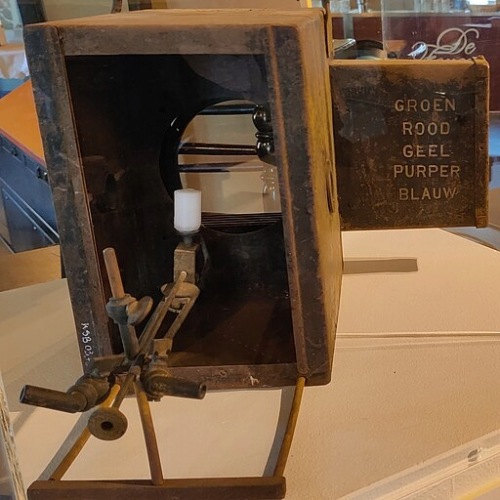
For most of human history, theaters depended on natural light. The ancient Greeks built their amphitheaters oriented to catch the sun. Indoor theaters in the 1500s and 1600s relied on candles and oil lamps that could not be dimmed, directed, or focused. When gas lighting arrived in American theaters around 1816, it was a significant improvement, but gas lines leaked, exploded, and regularly caused deadly fires. Audiences sometimes fell ill from the fumes. The real breakthrough came in 1825, when Scottish engineer Thomas Drummond discovered that heating a cylinder of calcium oxide (quicklime) with jets of burning oxygen and hydrogen produced an extraordinarily bright, focused white light. By the 1860s, "limelights" were being used in theaters around the world as the first true theatrical spotlights.
Why It Matters
The limelight achieved something no previous technology could: it allowed a lighting operator to direct a focused beam of intense light onto a specific performer on stage. For the first time, the audience's attention could be shaped with light. Each limelight needed a dedicated operator who had to constantly adjust the burning lime block and manage two pressurized gas cylinders—a demanding and dangerous job. The phrase "in the limelight" entered common language to mean being the center of attention. Carbon arc spotlights eventually replaced limelights in the late 1800s, and by the mid-20th century, xenon and discharge lamp followspots became the standard. The first Super Trouper followspots, introduced in 1956, became iconic fixtures on Broadway and in arena concert touring. Today's followspot operators use LED and xenon sources, but the core job remains remarkably similar to what those first lime operators did over 160 years ago: track a performer with a beam of light, adjust the size and brightness in real time, and stay perfectly in sync with the show's rhythm.