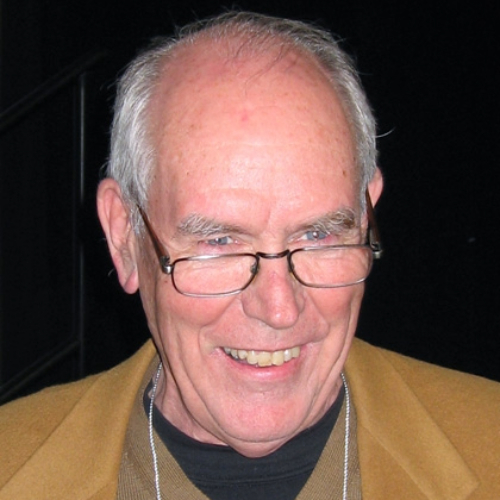
Photo: Dick Lyon, CC BY-SA 3.0 <https://creativecommons.org/licenses/by-sa/3.0>, via Wikimedia Commons
Who He Is
Before virtual reality had a name, Ivan Sutherland was already building it. In 1963, while still a doctoral student at MIT, he created Sketchpad, the first program that allowed users to interact with a computer graphically using a light pen rather than typed commands, establishing the idea that computers could be visual and spatial rather than purely textual. In 1968, working at Harvard, he built the first head-mounted display system, a device that tracked a user's head movements and displayed corresponding computer-generated graphics, which was so heavy it had to be suspended from the ceiling by a mechanical arm and became known as the Sword of Damocles. Sutherland later co-founded one of the first computer graphics companies and trained generations of researchers who went on to build the modern technology industry. He received the Turing Award, often called the Nobel Prize of computing, in 1988, in recognition of a career that touched nearly every corner of computer graphics and interactive technology.
Why He Matters
Ivan Sutherland asked a question in 1965 that AR/VR developers are still answering today: what would it mean to build a display so convincing that the viewer cannot tell it from reality? That question, which he called the Ultimate Display, has guided the entire arc of immersive technology research for sixty years. Every headset, every spatial computing platform, and every virtual environment built today is a direct descendant of the ideas he put on paper before the technology existed to realize them. Sutherland's career demonstrates that the most consequential contributions to a field are often not the finished products but the questions that orient everyone who comes after.