Photo: NASA/JPL, Public domain, via Wikimedia Commons
Overview
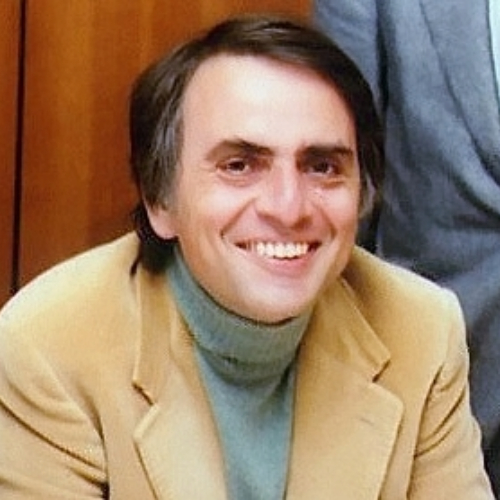
Carl Sagan grew up in Brooklyn as the son of a garment worker and a housewife. He fell in love with the stars at an age when most children are still figuring out how to read. He earned his doctorate in astronomy and astrophysics from the University of Chicago and spent most of his career as a professor at Cornell University, where he directed the Laboratory for Planetary Studies and contributed to some of NASA's most significant early space exploration missions, including the Voyager and Viking programs. He was one of the first scientists to take the question of extraterrestrial life seriously as a scientific subject, and he cofounded the Planetary Society, the world's largest space advocacy organization. His 1980 television series Cosmos: A Personal Voyage was watched by more than 500 million people in sixty countries and remains one of the most successful science communication projects in history. His novel Contact, published in 1985, was later adapted into a film and introduced generations of readers to the intellectual thrill of searching for life beyond Earth.
Why He Matters
Sagan demonstrated something that very few scientists of his generation attempted: that rigorous original research and the gift of making that research understandable to everyone are not in tension with each other but are actually two expressions of the same commitment to knowledge. His colleagues sometimes looked down on his public-facing work, viewing it as beneath the dignity of serious science, but Sagan understood that science only fulfills its promise when it reaches people. His ability to stand at the edge of what was known about the universe and describe it in language that made ordinary people feel the scale and wonder of it changed how millions of people related to science. For students drawn to the professor's life, his career is a powerful argument that the best teaching does not stop at the classroom door. The most important thing a professor can do is make people feel that knowledge is not a private possession but a shared inheritance.