Photo: Cmongirl, Public domain, via Wikimedia Commons
Overview
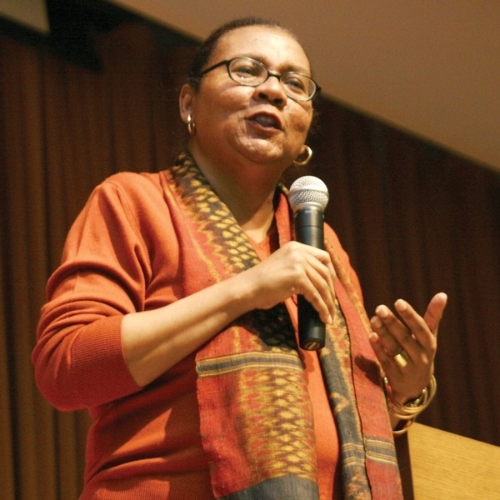
bell hooks, who spelled her name in lowercase as a deliberate stylistic choice, was born Gloria Jean Watkins in Kentucky in 1952 and grew up in a segregated South that gave her an early and visceral education in how systems of power shape daily life. She earned her undergraduate degree from Stanford University and her doctorate from the University of California, Santa Cruz, and went on to teach at some of the country's most prominent universities, including Yale, Oberlin, and City College of New York. Her first book, Ain't I a Woman: Black Women and Feminism, was written when she was still an undergraduate and published in 1981, launching a prolific career that eventually produced more than thirty books spanning literary criticism, cultural theory, memoir, and children's literature. She believed deeply that the classroom was one of the most powerful sites of transformation in society, and her 1994 book Teaching to Transgress became one of the most widely read works on pedagogy ever written. She taught until the end of her life, returning to her home state to hold a distinguished professorship at Berea College in Kentucky, where she died in 2021.
Why She Matters
hooks made two contributions that are rare to find in the same career: she produced original scholarship that changed how people think about race, gender, and culture, and she wrote about teaching in a way that made other educators want to be better at it. Her argument that education should be a practice of freedom, not a process of transferring information from an expert to a passive recipient, challenged professors' understanding of their role in the classroom. She wrote for general audiences as well as academic ones, which was itself a statement about who knowledge belongs to and who should have access to it. For students considering a career in education or academia, her life is a reminder that the most powerful intellectual work is often the kind that refuses to stay inside the university's walls. She demonstrated that a professor's reach can extend far beyond any single institution, discipline, or generation.