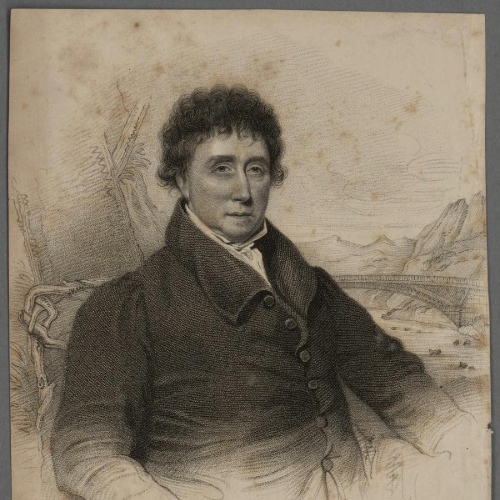
Photo: Henry Hoppner Meyer, Public domain, via Wikimedia Commons
Who He Was
Thomas Telford (1757 to 1834) was born in a hill farm in Eskdale, Scotland, the son of a shepherd who died soon after he was born. He grew up poor, and at 14 he was apprenticed to a stonemason. Some of his earliest work can still be seen on the bridge across the River Esk in the town of Langholm. In 1780 he went to Edinburgh to work as a mason on the city's New Town, and in 1782 he moved to London, where he worked on Somerset House and was promoted to first-class mason. He taught himself architectural drawing in his spare time. That self-education, plus a wealthy patron, carried him from stonemason to Surveyor of Public Works for the county of Shropshire in 1787, and from there to a career as one of the most prolific civil engineers in history: canals, harbors, roads, and bridges, including the Menai Suspension Bridge in Wales.
Why He Matters
Telford is the clearest example in history of where a mason's skills can lead. Everything he built as an engineer rested on what he learned with a chisel and a trowel: how stone carries weight, how a joint should be cut, how a structure fails. He became the first president of the Institution of Civil Engineers in 1818 and held the post until his death, and the English town of Telford is named after him. For a young person laying their first course of brick, his story reminds us that the trade is a foundation, not a ceiling.