Photo: Noah Wulf, CC BY-SA 4.0 <https://creativecommons.org/licenses/by-sa/4.0>, via Wikimedia Commons
The Ivanpah Solar Electric Generating System
What It Is
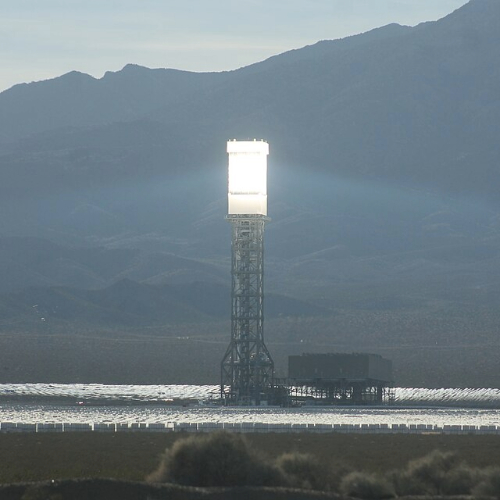
Spread across five square miles of the Mojave Desert on the California-Nevada border, the Ivanpah Solar Electric Generating System is one of the largest and most unusual solar installations ever built. Rather than converting sunlight directly into electricity with panels, Ivanpah uses 173,500 computer-controlled mirrors called heliostats to focus sunlight onto three 459-foot towers, heating water to steam that drives turbines to generate power, much like a conventional power plant. Each heliostat tracks the sun independently throughout the day, adjusting its angle every few seconds to keep the beam of concentrated light aimed precisely at the tower. The facility can generate enough electricity to power more than 140,000 homes and took four years and thousands of workers to build. It stands as one of the most dramatic demonstrations of what solar technology can look like beyond the rooftop panel.
Why It Matters
Ivanpah matters because it expands what most people think of as solar installation. The technicians who built and maintain that facility work with robotics, precision optics, steam turbine systems, and industrial electrical infrastructure at a scale that has almost nothing in common with a residential rooftop job, yet it is all part of the same growing industry. The project also illustrates the engineering and logistical complexity that goes into utility-scale solar development, where the installation itself is a years-long construction project involving hundreds of specialized workers. For anyone drawn to solar as a career, Ivanpah is a window into just how varied and technically ambitious the work can become at the highest levels of the field. The same curiosity about how sunlight becomes electricity that starts on a residential rooftop can eventually lead to systems that look nothing like what you imagined when you started.