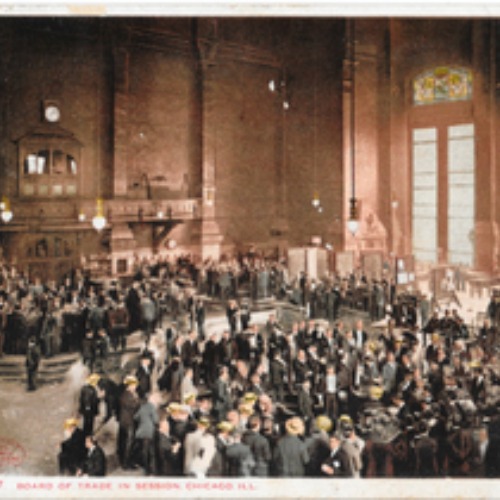
Photo: Detroit Publishing Co., Public domain, via Wikimedia Commons
What It Is
In 1848, a group of Chicago grain merchants gathered to solve a problem that was making agriculture across the Midwest nearly unworkable. Farmers would arrive in the city after harvest with wagonloads of grain, but there was no reliable system for setting prices, no way to guarantee a buyer would be waiting, and no mechanism for planning ahead. The Chicago Board of Trade was founded to fix that, creating the first organized commodity futures market in the United States. A futures contract allowed a farmer to agree today on the price they would receive for grain they had not yet harvested, and allowed a buyer to lock in their costs months in advance. The system transformed agricultural commerce almost immediately, bringing stability and predictability to an industry that had previously operated on luck and informal handshakes. Today, the Chicago Board of Trade, now part of the CME Group, processes trillions of dollars in agricultural contracts annually and sets benchmark prices for corn, wheat, soybeans, and dozens of other commodities that agribusiness managers around the world use every single day.
Why It Matters
The commodity futures market that the Chicago Board of Trade invented is the invisible infrastructure underneath nearly every agribusiness decision made anywhere on Earth. When an agribusiness manager decides whether to lock in a price for next season's corn crop or wait for the market to move, they are using a system built in a Chicago warehouse in 1848. The institution also demonstrated that solving the right business problem at the right moment can reshape an entire industry's structure for generations. The Chicago Board of Trade is a vivid example of how financial innovation and agricultural expertise can combine to create something that changes the world in ways its founders never fully anticipated.