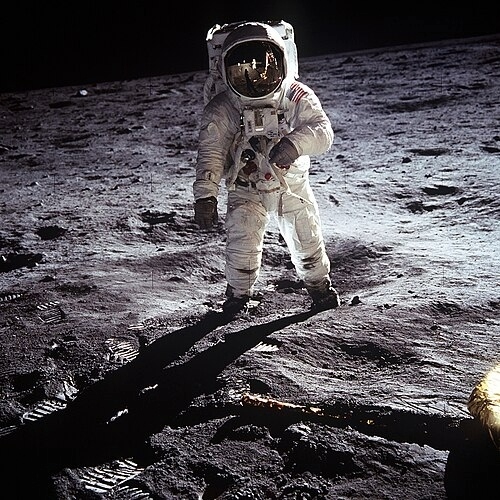
Photo: Neil A. Armstrong, Public domain, via Wikimedia Commons
The Apollo Program's Procurement Operation
What It Is
When NASA set out to land a human being on the moon in the 1960s, it faced a procurement challenge unlike anything that had ever been attempted. The Apollo program required approximately 400,000 contractors and suppliers working across more than 20,000 companies and universities, producing everything from rocket engines and spacesuits to freeze-dried food and navigation computers. No single company could build a spacecraft alone, which meant NASA's procurement specialists had to identify, vet, negotiate with, and manage an enormous network of suppliers, many of whom were developing entirely new technologies with no existing market price. They wrote contracts for products that did not yet exist, set quality standards for materials that had never been manufactured before, and coordinated deliveries on timelines where a single late shipment could delay a mission by months.
Why It Matters
The Apollo procurement operation demonstrated something that is easy to overlook when thinking about historic achievements: that the engineering and scientific breakthroughs that put humans on the moon were only possible because thousands of purchasing decisions were made correctly, on time, and to an extraordinary standard of quality. A rocket that fails because a contractor delivered substandard components is not an engineering failure; it is a procurement failure. NASA's procurement specialists developed contracting methods, quality assurance standards, and supplier management practices during the Apollo era that are still used by governments and corporations around the world today. The moon landing was one of humanity's greatest achievements, and procurement was part of the foundation it was built on.