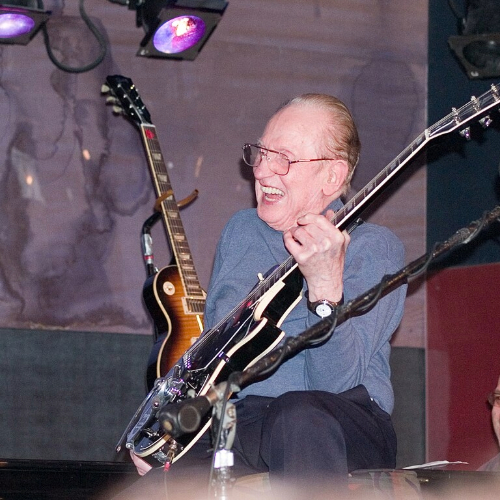
Photo: Arnoldius, CC BY-SA 3.0 <https://creativecommons.org/licenses/by-sa/3.0>, via Wikimedia Commons
What It Is
Before the late 1940s, every sound recording was made during a single live performance. If a band wanted to record a song, all musicians had to play together at the same time into the same microphone. There was no way to go back and fix a mistake, add another instrument, or adjust the balance after recording. A guitarist and inventor named Les Paul (1915–2009) changed everything. Working in a garage studio in Hollywood, Paul discovered that he could record one musical part onto a wax disc, then play that disc back through headphones and record himself playing a second part onto a new disc. By repeating this process, he could create complex arrangements with many layered parts, all performed by one person. His 1948 recordings of "Lover" and "Brazil" amazed listeners who couldn't understand how a single guitarist was producing such detailed, multi-layered music.
Why It Matters
Les Paul's disc-to-disc method was revolutionary but fragile. A mistake on the twelfth layer meant starting over from scratch. When his friend Bing Crosby gave him one of the first commercial tape recorders, an Ampex Model 200A, Paul immediately modified it by adding a second playback head, inventing what he called "sound on sound" recording. In 1953, he went further, convincing Ampex to build the first eight-track tape recorder to his specifications. For the first time, eight separate recordings could exist independently on the same piece of tape, each one recordable and editable without affecting the others. This was the birth of multitrack recording, the technology that underpins virtually all modern sound production. Every song recorded in a studio, every film soundtrack, every podcast, every video game score, and every piece of audio content created with a digital audio workstation traces its origins directly to Les Paul's inventions. He is the only person in history to be inducted into both the National Inventors Hall of Fame and the Rock and Roll Hall of Fame. NASA even adapted his multitracking concepts to handle complex data during the space program. His legacy reaches far beyond music into every corner of recorded sound.