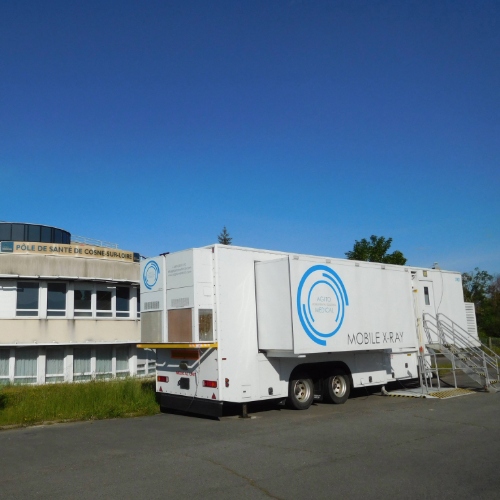
Photo: Cjp24, CC BY-SA 4.0 <https://creativecommons.org/licenses/by-sa/4.0>, via Wikimedia Commons
Mobile Chest X-Ray Screening Campaigns
What It Is
In the summer of 1947, Minneapolis set out to give a chest X-ray to every resident 15 and older. The city divided its map into numbered districts, and mobile X-ray units visited each one in turn. Between May and August, eleven mobile and portable units took about 306,000 chest X-rays on small film, in a city of roughly half a million people. The goal was to find tuberculosis, a serious lung disease, early, often before people knew they were sick. X-ray technicians, the job now called radiologic technologists, took the X-rays on mobile screening units like these in communities across the country.
Why It Matters
The Minneapolis survey found 98 people with active tuberculosis, and only 9 of them were already known to the health department. More than half of those patients went to a sanatorium, a special hospital for treatment and rest, and new medicines, starting with streptomycin in the late 1940s and isoniazid in 1952, began to change how tuberculosis was treated. Nationally, the U.S. Public Health Service’s mobile screening program examined about 20 million people before it ended in 1953, partly because the mobile units were expensive to run. In 1974, World Health Organization experts recommended ending mass chest X-ray screening because it cost too much and an X-ray alone could not confirm the disease.