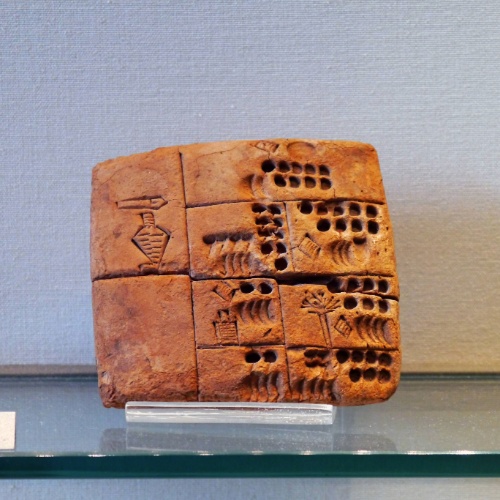
Photo: Louvre Museum, Public domain, via Wikimedia Commons
What It Is
About 5,000 years ago in Mesopotamia, in what is now Iraq, people kept records by pressing marks into soft clay tablets. A group of very early tablets from the ancient city of Uruk tracks large amounts of barley, an important grain, and more than a dozen of them carry the same name: Kushim. The most famous one lists thousands of measures of barley collected over 37 months, followed by Kushim's name. Many historians read it as a receipt signed by Kushim, much like an accountant approving a receipt today. Some scholars think Kushim may have been a job title rather than a person's name, but if it was a name, it is one of the oldest names of any person ever written down.
Why It Matters
The Kushim tablets show that keeping track of goods was one of the very first reasons people invented writing at all. Before stories, poems, or laws were written down, people needed a reliable way to remember who owed what and how much was stored. Historian Yuval Noah Harari has pointed out that one of the first names we know from history belongs not to a king or a hero, but to someone who kept the books. That tells us how essential accounting has been to building cities, trade, and communities from the very beginning. For young people, Kushim is a fun reminder that record-keeping is one of humanity's oldest and most important jobs.