Photo: Semaforo GMS, CC BY-SA 4.0 <https://creativecommons.org/licenses/by-sa/4.0>, via Wikimedia Commons
Overview
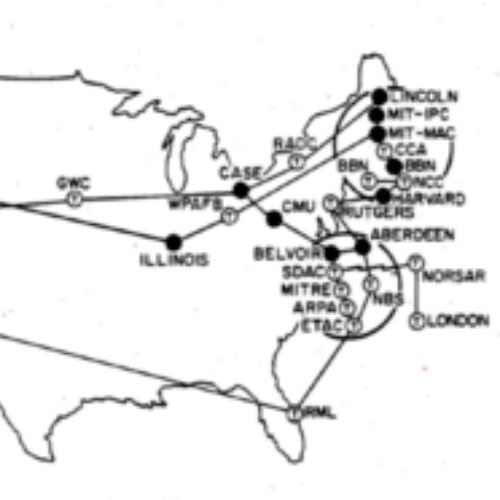
ARPANET was the world's first operational computer network and the direct predecessor of the internet as we know it today. Funded by the United States Department of Defense and launched in 1969, it was designed to enable researchers at different universities and laboratories to share information and computing resources with each other across long distances for the first time. The first message ever sent over ARPANET was attempted between UCLA and Stanford Research Institute in October 1969. It was supposed to read "login," but the system crashed after just two letters, and only "lo" arrived. By 1971, the network connected 23 nodes across the country, and the protocols developed to run it became the foundation on which the entire modern internet was eventually built.
Why It Matters
ARPANET proved that computers could talk to each other across distances, which was neither obvious nor inevitable at the time. The engineers who built it had to invent entirely new ways of thinking about how information could be broken into pieces, sent through a network, and reassembled correctly on the other end, a concept called packet switching that still underlies every message, video, and search you make online today. Understanding the ARPANET is understanding the origin story of the digital world, and it is a reminder that the infrastructure most people take for granted was designed by engineers who were solving problems no one had ever solved before. Every network and cloud systems engineer working today is building on the foundation those first engineers laid.