Photo: Created with Google Gemini
Overview
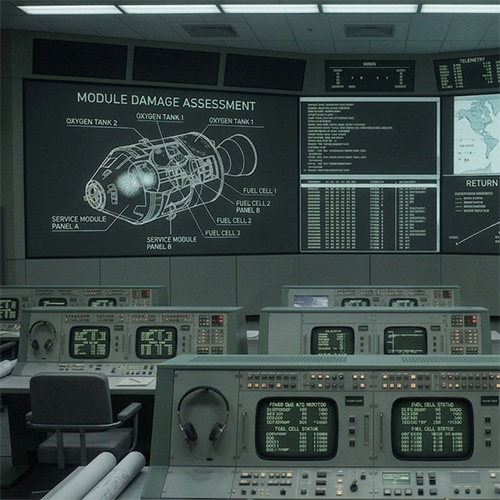
When NASA launched Apollo 13 in April 1970, the mission had already been shaped by years of actuarial-style risk modeling. Engineers and analysts had calculated the probability of failure across thousands of individual components, identifying which systems were most likely to fail and building redundancies and contingency protocols around them. When an oxygen tank exploded 56 hours into the mission, the crew was 200,000 miles from Earth with a crippled spacecraft. The fact that they survived was not luck. It was the result of meticulous advance planning that anticipated failure scenarios and prepared responses. The mission became one of the most dramatic demonstrations in history of what rigorous risk analysis can accomplish.
Why It Matters
Apollo 13 shows what actuarial thinking looks like in life-or-death conditions. The same logic that helps an insurance company prepare for an unlikely but catastrophic event helped NASA bring three astronauts home from the edge of disaster. Risk modeling is not about predicting exactly what will go wrong. It is about preparing for the full range of what could go wrong, so that when something does, the consequences can be managed. For young people, Apollo 13 is a vivid reminder that the math behind risk analysis is not abstract. It is the difference between survival and catastrophe.