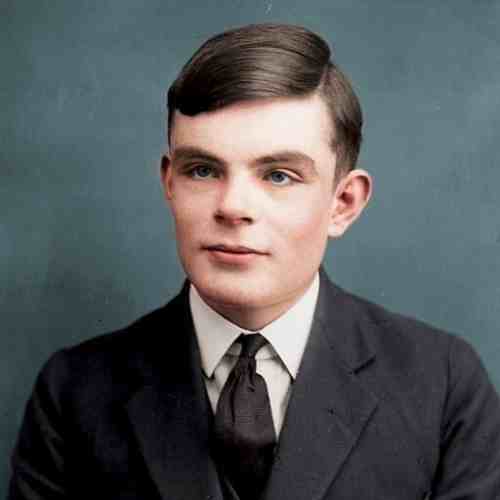
Photo: Possibly Arthur Reginald Chaffin (1893-1954), colorized by @frommonotopoly, Public domain, via Wikimedia Commons
Overview
Alan Turing was a British mathematician, logician, and codebreaker whose work laid the foundation for modern computing and cybersecurity. Born in London in 1912, Turing showed extraordinary mathematical ability from a young age and went on to study at Cambridge University and Princeton. During World War II, he led the team at Bletchley Park that cracked the Nazi military's Enigma code, a system the Germans believed was unbreakable. His work developing machines to decrypt enemy communications is estimated to have shortened the war by roughly two years and saved countless lives. After the war, Turing published groundbreaking papers on artificial intelligence and designed one of the earliest stored-program computers.
Why He Matters
Alan Turing's work is the intellectual foundation on which both computer science and cybersecurity are built. His wartime codebreaking demonstrated that encrypted information could be cracked through logic, mathematics, and creative thinking, the same principles cybersecurity analysts use today. Turing's life also carries an important lesson about fairness and recognition. Despite his enormous contributions, he was persecuted by the British government for being gay and received a posthumous royal pardon in 2013. For young people interested in cybersecurity, Turing's story shows that protecting information has always been one of the most consequential applications of human intelligence.