Photo: Various, CC BY-SA 4.0 <https://creativecommons.org/licenses/by-sa/4.0>, via Wikimedia Commons
Overview
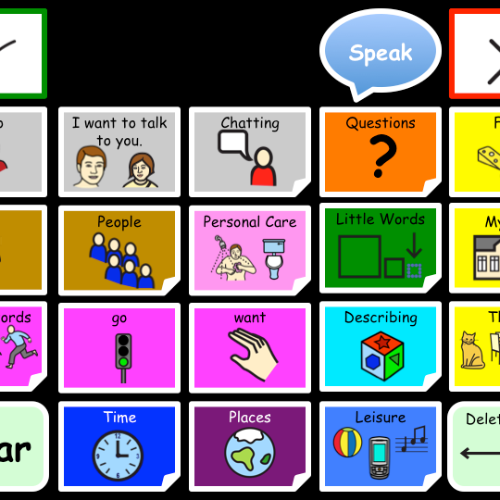
For millions of people worldwide, speaking out loud isn't possible. Some were born with conditions like cerebral palsy or autism that affect speech, while others lost their voice to ALS, a stroke, or a brain injury. Augmentative and Alternative Communication, or AAC, is the field of tools and strategies that changes that reality. AAC ranges from simple picture boards and alphabet charts to sophisticated speech-generating devices operated by touch, eye gaze, or brain signals alone. Stephen Hawking, the physicist whose ideas reshaped our understanding of the universe, communicated for decades using an AAC device that became one of the world's most recognized voices in the world. Speech-language pathologists are at the center of this work, evaluating each person's needs, matching them with the right system, and advocating to make sure access is never out of reach.
Why It Matters
AAC technology has revealed something important: the inability to speak is not the same as having nothing to say. Children once assumed to be unaware of the world around them have used AAC devices to demonstrate sharp minds, strong opinions, and deep emotional lives. Adults who lost speech have used these tools to keep working, maintain relationships, and tell their own stories. Every generation of advances, from smarter vocabulary prediction to eye-tracking systems precise enough to be controlled by a single glance, opens more doors for more people. For SLPs working in this space, the job is not just clinical. It is the work of giving someone access to their own voice, which is one of the most fundamental things one person can do for another.